


President Trump, that great orange casino sphinx of our degenerate age, has once more descended upon the Republic like a rabid parasitic god, reaping in his first year back in the White House a windfall so obscene it would have made even Midas blush. About $1.4 billion slithered forth from the family’s cryptocurrency businesses alone, shimmering, spectral scam coins, born from nothing, multiplying in the ether like mould on forgotten bread. All told, Trump pulled in at least $2.2 billion, a figure that swallows up his real estate holdings and whatever other sticky tentacles of empire that still twitch in his grasp. It’s almost beautiful, in the way that certain deep-sea horrors are beautiful, translucent, many-tentacled, glowing with their own bioluminescent corruption.
The president, in his Mar-a-Lago twilight, surrounded by ledgers that glow with unholy light, as Trump coin and Bitcoin and whatever fresh digital slime the markets have birthed that week congeal into solid, vulgar illgotten wealth. The family enterprise, that strange hybrid of hotel chain, meme factory, and sovereign statelet, humming along like some vast subterranean machine fed on attention and grievance. Outside, the republic creaks under its usual burdens: housing, healthcare, cost of living, wars in the Middle East, and other such trivialities. Inside, the scam coins rain down in torrents, each one a tiny monument to the triumph of the internet over matter.
How fitting, in this late-stage crypto carnival of our civilisation, that the highest office in the United States should be so gloriously monetised. The old republic of yeoman farmers, Minutemen and enlightenment gentlemen has long since dissolved into slurry; what remains is a man who turned the presidency itself into content, and content into coin, until the distinction between governance and grift became as thin and insubstantial as a blockchain receipt. The windfall is not merely financial; it’s metaphysical. Trump has always understood the deepest truth of our era, that reality itself is negotiable, that value can be willed into being through sheer repetition and spectacle, that the emperor’s new clothes are, in fact, NFTs. And so the billions accumulate, vast and glistening, while the rest of us shuffle along, pretending the system still makes sense. The numbers are staggering, yes, but they are also inevitable. In the kingdom of the spectacle, the spectacle always pays best.
One of Trump’s biggest hauls arrived when an investment firm tied to the United Arab Emirates, those sleek, completely uncorrupt desert potentates with their petrodollars and air-conditioned megacities, swept in and devoured nearly half of the Trump family’s flagship crypto venture, World Liberty Financial. A transaction vast and lubricious, that 49% of the Trump company swallowed in one glistening gulp, the sort of deal that leaves the air thick with the smell of sand, oil, and newly minted digital nothing. Here is the Trump empire’s logic laid bare, the sacred line between foreign policy and private enterprise not just blurred but dissolved entirely into a warm, oozing colloid, like ink bleeding through the pages of some half-forgotten treaty. What is diplomacy, after all, if not another species of grift? What are sovereign states if not rival firms haggling over slices of the same spectral pie?
The sheikhs, lounging in their marble halls beneath artificial skies, extended their golden tentacles across the ocean and found the Trump organism already pulsing there, ready to be financially fertilised. World Liberty Financial: a name like a Trump Tower rendered in blockchain, a monument to the idea that freedom might be tokenised and sold back to you at a premium. In rushed the Emirati capital, vast and anonymous, buying not merely equity but proximity, access to the ear, the brand, the aura of the childlike King himself. A state actor purchases a chunk of the presidential bloodline’s latest alchemical scheme, and suddenly the republic’s foreign policy acquires the faint, unmistakable tang of family branding.
I suppose this is not corruption in the old, vulgar Tammany Hall or 1990’s Fianna Fáil sense. Corruption implies some shameful deviation from a norm. No: this is the norm ignored, a convergence of contempt for democracy and direct deposits to Trump’s bank accounts. The desert winds whispered through the smart contracts, petrodollars metastasised into crypto-tokens, and somewhere in the marbled halls of power an invisible ledger ticked upwards, vast and indifferent, while the rest of us were left to contemplate the sublime spectacle of Trump’s republic auctioning off its soul. There are no blurred lines here; no guardrails, no constitutional limits, they simply don't exist. The United States Constitution is incapable of holding an 80-year-old, corrupt child King to account. But the much vaunted media and political apparatuses are also unwilling or unable to do so. Why do you insist on calling yourselves a democracy?
Just as the great orange golem lurched back into the White House for the second time, like some half-forgotten revenant from a nightmare you thought you’d finally shaken off, a cabal of sleek emissaries from the Abu Dhabi royals, princes of petrodollars and absolute discretion, slipped into the shadows and inked a pact with the Trump bloodline. They were buying a forty-nine per cent slice of the family’s latest glittering grift: some half-baked cryptocurrency venture, still wet and larval, pulsing with the usual promises of infinite wealth conjured from pure vapour. Half a billion dollars for the privilege. Half of it up front, naturally, funnelling hundreds of millions straight into the sticky palms of Trump family entities, those sacred vessels that have never once encountered a dollar they didn’t immediately transmute into gold-plated golf courses, legal bills, or fresh veneers of self-regard. And then, with the straightest of faces and the oiliest of voices, we are solemnly asked to believe that none of it has the slightest thing to do with anything else. One is a perfectly ordinary private transaction between consenting billionaires; the other is high statesmanship, visionary partnership, the noble sharing of tomorrow’s technology between trusted allies. Pure coincidence, mere happenstance, the sort of thing that occurs every day in a world governed by invisible and benevolent market forces. Sure, it’s not like Trump has done this before.
Meanwhile, the United Arab Emirates and the United States, two great throbbing organs of late-imperial capital, signed a grand covenant during Donald Trump’s ceremonial victory lap through the Middle East last year. The Gulf petro-monarchy, already swimming in black gold and sovereign wealth, would erect the largest artificial intelligence campus anywhere outside the United States itself. A gleaming necropolis of servers and silicon, humming in the desert heat like some colossal, half-sentient djinn newly unbound by tech. One of several such deals, each more lubricated than the last, all of them dripping with the promise of synergy, innovation, and other such glittering euphemisms for raw, unaccountable power. It was just a coincidence that the UAE bought a 49% share in the Trump families crytpo thimblerig while the UAE got access to the most coveted hardware in tech. Behold the true circuitry of our age: while the Trump clan quietly pockets its crypto tithe from Abu Dhabi princelings, the same hands are busy wiring the future itself into the emirates’ sun-blasted soil. Artificial intelligence, not the tame, helpful kind that writes your emails or generates pictures of cats in top hats, but the real thing, the god-machine, the thing that dreams in mathematics and hungers for dominion, will now have its grandest extraterritorial temple rising amid the dunes of the UAE. A campus vast enough to swallow entire cities of data, tended by those who already understand that sovereignty in the twenty-first century belongs not to nations but to whoever controls the largest cluster of GPUs in data centres.
We are invited to admire the scenery while the transaction completes. The orange showman jets between golden palaces, signing papers that will outlive every constitution ever written. The servers will blink awake in the desert. The blockchain will slither. And somewhere, in air-conditioned boardrooms where the future is priced to the nearest decimal, men in immaculate robes and men in red ties will shake hands over the corpse of whatever used to be called the public interest. Nothing to see here. Move along. The age of miracles is upon us, and it smells of server coolant and crude oil.
It gets worse…….
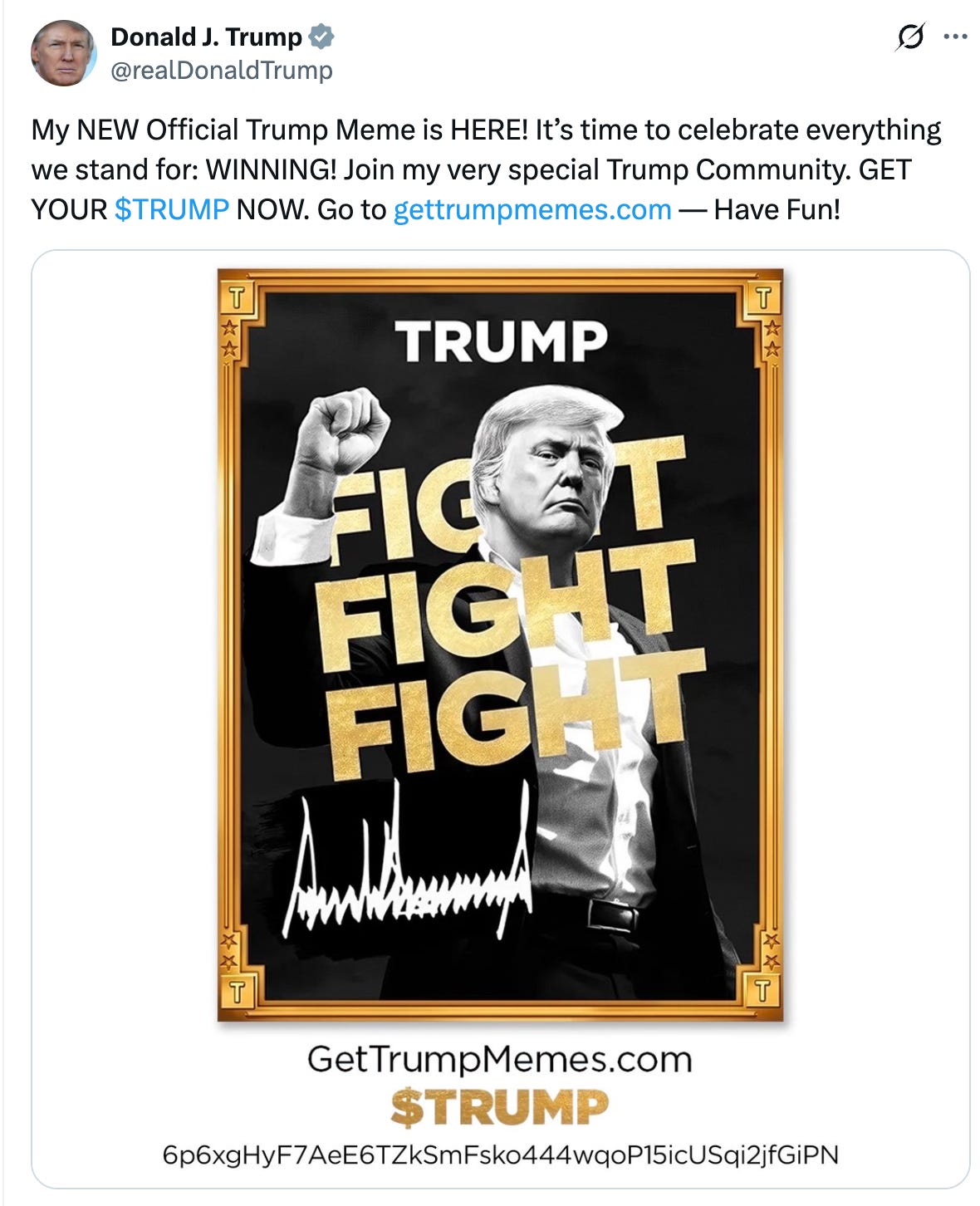
The New York Times is reporting that nearly a Million Investors Lost a Total of $3.8 Billion on Trumpcoin. Stop laughing down the back! Nearly one million souls, devout Trump followers, freshly converted into crypto investors, wide-eyed pilgrims of the digital gold rush/scam, have lost money. According to Nansen, the cryptocurrency analytics firm that moves through blockchain ledgers like a medieval scribe through illuminated manuscripts, the collective wounds amount to some $3.81 billion in losses for the Trump zealots. A hecatomb of small fortunes, pension scraps, stimulus cheques, and desperate savings, all vaporised into the desert air. One million individual tragedies, each no doubt accompanied by its own private howl of betrayal, now reduced to a single clean, horrifying number. This audit arrives in the same week that President Trump, with the serene satisfaction of a man who has never once been on the losing side of a deal, signed his annual financial disclosure. There it was, glowing like a sacred relic: a cool $636 million payout from the very same memecoin venture. Part of a broader harvest of at least $2.2 billion reaped from his various business undertakings in 2025 alone. While the faithful bled out in the comments section of Truth Social, their saviour was quietly counting his shekels in the counting-house. The token is down roughly 97.7% from its all-time high of $75.35; it is currently trading in the $1.69 – $1.87 price range. How did they think this would go? Have these people not heard of Trump University, Trump Vodka, Trump Bookings and Trump Casinos? Even I, in the boondocks of rural Ireland, had heard of all those scams.
The odds, ya see, were never in doubt. This was never a game of chance; it was the extraction from the gullible, the naive, the sucker, the imbecile, dressed up as populist prophecy, “we’re going to the moon”. Trump profited whether his glittering digital token rose like a phoenix or came down like Icarus on a bad acid trip. Every frantic trade, every desperate bag-holder’s sale, every fresh convert FOMO-ing in at the top generated a little skim, a little toll, a little cream for the house. He urged them on, of course, hammering the coin day after day from his bespoke digital pulpit on Truth Social, that great roaring agora of the aggrieved. “Buy my coin, folks, it’s going to the moon, believe me, tremendous gains, the best gains.” And they did. They always buy into him.
And so the question hangs in the air like the stench of something long dead and still twitching: how, precisely, is the President of the United States permitted to fleece nearly a million of his own worshippers out of nearly four billion dollars while still squatting in the Oval Office? Where, in this great creaking machine of parchment and precedent, is the mechanism that was supposed to prevent a man from turning the highest office in the land into a private slot machine, one that pays out only to the house?
We are invited, once again, to consult the noble words in the sacred texts. The Constitution, that brittle old scroll of Enlightenment optimism, that yellowing map drawn by men who had never imagined a world in which power could be converted into memecoins at the speed of light. It speaks of high crimes and misdemeanours, of impeachment, the tyranny of unaccountable Kings, and removal, of the careful separation of the person from the office. It does not, it turns out, contain a single clause that says “thou shalt not launch a speculative digital con token from the Resolute Desk and then profit obscenely from every desperate trade made by thy followers.” The framers, bless their powdered wigs, simply never thought to forbid the President from running a casino in which the chips are faith itself and the house edge is enforced by presidential tweet.
The laws are there, of course. Emoluments clauses, conflict-of-interest statutes, campaign-finance rules, the entire baroque scaffolding of ethics regulations meant to keep the Republic from devolving into a straightforward kleptocracy. They exist. They are enforced, from time to time, against lesser mortals. But they have developed a curious, almost gymnastic flexibility when applied to a man who has already demonstrated that the institutions are unwilling or unable to treat that despicable current custodian of what is meant to be a great democracy as subject to them. The guardrails, those famous guardrails, have been revealed as little more than painted lines on a fence that has already collapsed into the ravine. They look impressive from a distance. Up close, they are revealed to be suggestions, traditions, norms, things that only function if everyone agrees to pretend they still matter.
What remains is the raw fact of power. A President who can command the attention of tens of millions at any hour of the day, who can transmute that attention into trading volume on a token he himself controls, who can then collect fees on every transaction while the price gyrates according to his own caprice or the caprice of his algorithmically amplified followers. Some would argue it’s the logical endpoint of a system that has spent decades hollowing itself out in the name of “disruption” and “innovation.” The Constitution of the U.S.A was never designed to withstand a reality in which the head of state could become, simultaneously, a reality-television character, a brand, and the operator of a global pump-and-dump scheme. It assumes a certain baseline of shame, a certain residual attachment to the idea that public office should be a noble thing and not merely another revenue stream for a reality TV star.
So the answer, such as it is, is that he is allowed because the constitutional machinery that was supposed to stop him has already been captured, or exhausted, or rendered something decorative. The laws still exist on paper. The regulations gather dust on the shelves. The guardrails still stand, rusting gently in the toxic glow of Trump’s republic. But the laws no longer bind. They no longer guard. They have become artefacts, like the marble columns in a building from a bygone age that has long since been converted into a casino. And inside that casino, the lights stay on, the chips keep changing hands, and the man at the centre table keeps smiling, because the house, this time, really does always win.
The latest episode of The Atlantic Current is out, where Vince and I discuss, amongst other things, an immigrant Mayor’s very shady timeline. Trump’s Crypto Con and America 250, and why Ireland does not have an Independence Day.
SPOTIFY
How Not To War

Let’s say you’re the President of the United States, sitting in Washington one day, looking at your approval ratings, the economy is not great, and all anyone can talk about is a paedophile named Epstein, and how you once knew him. You also might be involved in a massive criminal conspiracy. You get thinking:
Sublime writing about the Riduculous! Well done! 👍
"this is the norm ignored, a convergence of contempt for democracy and direct deposits to Trump’s bank accounts."
Trump is going to continue ripping everyone off for as long as he lives. GOP facilitates and enables him because many of them have their noses in the trough. I don't see how any of this is going to change, but it will somehow.