
Land of the Free, Home of the Hypocrites
Esta application is going get tricky

Freedom of speech and of the press in the USA was never meant to be a guarantee of comfort; it was a license for discomfort. It protected biting satire, harsh criticism, and inconvenient facts that governments would prefer to bury beneath a polished narrative of stability and success. Political scientists, polemicists and the plebs have long spoken about the USA’s First Amendment like it’s scripture. It is a sacred text, a prepossessing, brittle parchment promising the citizens of the United States the right to speak freely without fear of state oppression. But every scripture needs its heretics, its infidels, its unbelievers to define itself against. Enter the European tourist. The supplicant, asking permission to enter. For them, the scripture is inverted. It becomes not a shield or something to marvel at, but a blade held to their throat. Speak freely, it says. We dare you.
The proposed US rules turn the simple act of crossing a border into a kind of digital confession, demanding not just your passport, but the last five years of your online soul. In place of a welcome mat, foreign visitors are greeted by a one-way mirror, behind which officials pore over jokes, selfies, and late-night rants as if they were state secrets. The Esta application, once a mildly annoying online form, is being refashioned into a velvet rope, guarded by an algorithmic border guard who wants to see your entire social media past before letting you into the country. The promise that “nothing has changed” rings hollow when the price of admission is five years of your digital memories, sifted through for hints of “deception,” “fraud,” “regime crticism”, or being the wrong kind of outspoken. Under the banner of maximum vetting, the border morphs from a line on a map into a dragnet spread across your Instagram grids and Facebook memories.
What was once an optional nod to your online presence is now poised to become a mandatory confession booth, where every like, share, and sarcastic comment can be reinterpreted as evidence. The state, armed with vague notions of “additional concern,” reserves the right to treat irony as ideology and youthful posing as a potential threat. A birthday photo with the wrong slogan in the background, a retweet of an unpopular opinion, or a decade-old joke taken out of context could become a quiet strike against your name in a database you will never see, judged by officials you will never meet. This is not just about keeping out dangerous people; it is about teaching everyone else to behave online as if the border guard is always watching. The casual, messy humanity of social media grievances, political fury, and memes shared in poor taste becomes a liability when Trump’s regime demands it as a condition of entry. The message to would-be visitors, especially younger ones with dense online lives, is stark: sanitise your timelines, muzzle your opinions, and hope the machines and their masters decide you are sufficiently vapid to be allowed enter.
Trump’s administration is turning transatlantic travel into a loyalty exam, where the price of seeing the states is proving that your digital record contains no hint of ideological misalignment or controversial association. Those who refuse to submit their social history are quietly refused entry; those who comply are reminded that their presence is a conditional favour, revocable at the border with little explanation. The land that once sold itself as a beacon of free expression now signals, to millions abroad, that it prefers its visitors pre-sanitised, pre-scrutinised, and pre-emptively obedient to an ever more totalitarian administration.
The United States likes to talk about the First Amendment as if it were a shining shield protecting the republic, a piece of divine armour that guarantees a realm of pure, inviolable speech. It is a national symbol, the story America tells about itself: a country where words are free, where thoughts do not need permission to exist. The United States once imagined censorship as something that happens elsewhere, a medieval inquisitor rifling through forbidden books; now it simply asks you to bring the library yourself. Social media is a dossier you have been quietly compiling on yourself, and the government merely asks, with a bureaucrat’s politeness, to see the file. The border officer does not have to shout or ban a newspaper; they can simply scroll in silence and then smile slyly and say, “Your application has been refused.”
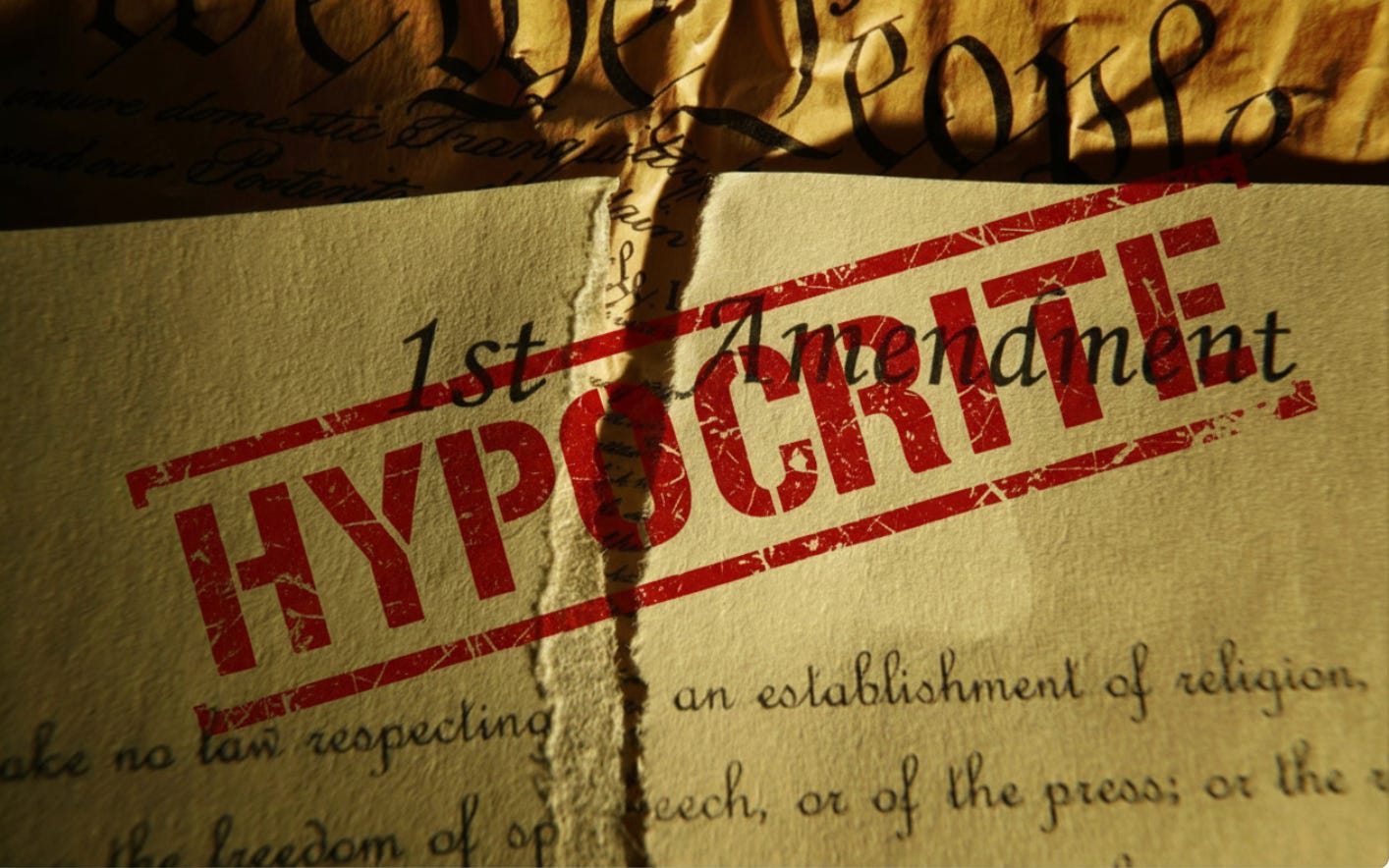
In theory, the First Amendment is supposed to ban exactly this kind of power: the power to make people weigh each word against the possibility of punishment. The text speaks of abridging speech, but the spirit goes deeper: it rejects the idea that the state can stand behind you every time you open your mouth and make you wonder if this, finally, is the sentence that will cost you something tangible. Yet the demand for social media history turns every past utterance into a potential landmine, buried years ago in some forgotten platform, waiting to go off when you need a visa. It is not an outright prohibition; it is a test. Free speech is reimagined as an exam you can fail retroactively.
The defenders of this system say: visiting the United States is a privilege, not a right. In that phrase, the mask slips. If speech is really a privilege, then the First Amendment is only a membership perk in an exclusive club, not a statement of principle about how power should treat human expression. The United States claims to be a universal champion of free speech, lecturing the world about its sacredness, but at the gate, it behaves like every small, suspicious state that demands ideological paperwork from strangers. “Show us what you have said,” the form insists, “and we will decide if you are the right kind of speaker.”
Social media makes this especially grotesque. These platforms are where people are at their least curated and most foolish: where they exaggerate, joke, try on borrowed anger, declare impossible love, are in a constant state of being offended, or share half‑understood political takes in the middle of the night. To treat this sprawling, chaotic mess as a neat bundle of “identifiers” for security vetting is to pretend that a human being can be weighed and measured in the churn of their posts or lack thereof. The state becomes a kind of digital augury, reading your memes the way Romans watched the flight of birds, seeking portents of danger in your sarcasm. It is not protection; it is superstition dressed up as data.
Meanwhile, the Trump administration strides onto the world stage and scolds Europe for its supposed timidity about speech. European hate‑speech laws and platform rules are denounced as creeping tyranny, as if Brussels were strangling speech with red tape while America’s hands remain bloodless. The United States presents itself as the last bastion of bold, unruly expression, sneering at the old continent’s attempts to regulate what can be said online. There is considerable discussion about “Western values” in the USA and how America is said to understand them better than anyone else. When they say America, they mean Trump, of course. A barely literate cozener masquerading as a statesman, all the while enabled by an imperial court of intellectual eunuchs.
But consider the contrast. Europe, for all its flaws, tends to regulate in public, through laws that can be debated, challenged, litigated, and criticised. The Trump regime does its work in the shadows, through quiet denials, invisible refusals, and sealed vetting procedures. A European regulation might tell you, bluntly, that a certain kind of thing can incur a fine. The American system, by contrast, can simply look at your five years of online life and decide that you are the wrong kind of person to admit, without ever saying which word condemned you. One is open censorship; the other is secret judgment. The latter is in many ways far more chilling.
And this is just the beginning. The Trump administration has further plans to be implemented “when feasible.” They will ask for the names and details of your entire family, parents, spouse, siblings, and children. A little family tree sketched not in love but in suspicion, each relative turned into a possible contaminant because you once shared a bathroom with them. They want every telephone number you’ve used in five years, every email address from the last decade. There is even, almost laughably, a provision for demanding DNA from applicants, though how one is meant to post one’s genetic code remains a mystery. Do you lick the monitor? Try to upload your chromosomes as a PDF?
This is the heart of the hypocrisy: the United States brandishes the First Amendment overseas as a holy relic abroad while treating the actual practice of speech, messy, emotional, contradictory, digital speech, as contraband at its own doorstep. It boasts that it does not criminalise your words; it only reserves the right to bar you from its territory because of them, and it calls itself the world’s home of free expression. So here we stand, the Land of the Free is refining its tools. It will soon ask not just for your passport and your tickets, but for the history of your heart and mind as it exists in the cloud, every joke, every grievance, every moment of weakness etched in binary. They want to know not just who you are, but who you have been, in the hope of divining who you might become. It is the merger of the state and the digital panopticon. Pack accordingly or avoid at all costs.
Trumps Calculated Derangement Syndrome

Trump does not simply insult people; he curates a small private bestiary and then stuffs you into it. On Air Force One, high above the earth in the whitish hum of Trump’s imperial power, the president of the United States turned to a woman whose job is to ask him questions on behalf of 330 million people and called her “Piggy.” Another insult in the vacuous sludge of Trumpian politics, but the White House hurried to assure everyone that this, too, was democracy in action.
We Canadians have noticed the change of mood in the US since the mango Mussolini ascended to the presidency. Our travel to South of our border has dropped by 40%( unfortunately we still have a lot of business with them). The move toward fascism is accelerating and we are almost in war(trade) mode . We are preparing ourselves for the decline of the American empire.😎🇨🇦
I've written enough dis-favor of this dys-administration in the past 5 days (five weeks; five months, five years; five f**king decades) that they wouldn't let me BACK in if I traveled out. Which I'm not doing, anyway, but;
I am so very, very angry that we have come to this. Thanks for this bit of clarity. We will be the poorer (in spirit) and stupider for having kept our 'neighbors' away. God bless the Irish.
Tim Long, Just Up the Hill from Lock 15.