
I'm Just A Poor European!
But at least I'm not deluded. Notes on that WSJ article.

The sight of a Wall Street Journal columnist weeping into his caviar for the plight of Europe’s poor is always a heart-warmer. God bless the Wall Street Journal and its tireless missionaries of American dynamism. Let me don my tricorn hat, load my musket with raw, unregulated hyper-capitalism, and offer a riposte to the most jaw-droppingly uncultured and unsophisticated op-ed I’ve read in many a long time. The delusional WSJ columnist, Joseph C. Sternberg, is worried we don’t know how poor we are in Europe. I’m in shock after digesting that drivel masquerading as a thought-piece. We’re in bliss, you see, in Europe. Blithely ignoring the fact that our per-capita output is slightly lower than Connecticut’s. But let’s puncture the bliss, shall we? Let’s take a scalpel to this comfortable delusion and perform a little transatlantic compare-and-contrast, the kind that leaves blood on the carpet. Let’s stare straight into the abyss and see exactly how comprehensively, how gloriously, how terminally fucked Europe really is, or is not.
How noble it must feel for the WSJ, perched atop that $94,400-per-head Olympus, peering down at the sad, stagnant Europeans shuffling about in our $65,000 GDP misery (Ireland’s is $130k), wondering why we haven’t yet prostrated ourselves before the altar of hyper capitalism enlightenment. The continent’s great existential question, according to the latest oracle from the Wall Street Journal, is this: when will we deluded welfare addicts in Europe finally shake off our socialist fever-dream and admit how wretchedly poor we are? When will we do the decent, grown-up thing and start fixing our addicction, by which, one presumes, the article means flinging the doors open to more venture capital, slashing away at sick days and annual leave like a Puritan with a riding crop, and embracing the American sacrament of drowning in medical debt while the bills pile up like funeral wreaths on the steps of our recently repossessed homes. All this, naturally, while organising our entire civilisation around the rigid worship of some two-hundred-and-fifty-year-old words, those brittle constitutional relics, as though they were handed down on Sinai rather than drafted by a committee of slave-owning Enlightenment gentlemen who never had to worry about waiting lists or insulin prices.
How illuminating of the Wall Street Journal. How infinitely generous of them, these high priests of the Dow Jones and the leveraged buyout, to descend from their ivory towers and offer us their guiding hand on the path to salvation, to show us poor, benighted Europeans the way out of our childish welfare garden and into the bright, sunlit uplands of proper American adulthood, where venture capital flows like holy water and bankruptcy is just another character-building sacrament.
The true genius of the American capitalist model, that holy place of greed is good in what used to pass for Freedom and liberty, (something we also have in abundance in Europe), is this: one morning you wake with a small, conspiratorial lump nestling under your skin, a reminder of your own mortality, and the republic responds not with pity, empathy or healing, but with paperwork. You will lie on a hospital bed in some fluorescent hallway for fourteen hours, a modern Stations of the Cross, while a nurse whose eyes have already seen too many deaths simply because people are poor, presses a single painkiller into your palm as if it were the last consecrated host. Then the bill arrives, twelve thousand dollars, itemised with the cold poetry of the damned, and your credit score collapses like a subprime mortgage in 2008. Perhaps you will have to pimp the children out to OnlyFans, or negotiate with debt collection agencies who speak in the serene, unhurried tones of minor demons who know they own your soul anyway.
Why should the hospital keep you alive when the same money might be deployed more efficiently in a stock buyback? A financial ritual by which capital eats its own tail and grows fatter. The hospital is not a place of healing; it is a derivatives market with worse lighting. If you can’t pay, they will come for the house, naturally. They always do. Congratulations: you are now bankrupt, or at least performing the contemporary American sacrament of crowdfunding your own continued existence while some insurance adjuster, a minor functionary of Moloch, explains with exquisite bureaucratic tenderness that your pre-existing condition has got to do with being human and your current plan falls outside the terms of the covenant. You know what Europe doesn’t do? It doesn’t hand you a bill for $40,000 because you gave birth. It doesn’t send bounty hunters after you for an MRI; we commit the vulgar indecency of simply treating you. No credit check. No GoFundMe interlude. No moral lecture about personal responsibility. As if cancer cares how hard you work. In Europe, we simply try to fix what is broken, like barbarians who have never heard of shareholder value. One almost blushes at the primitivism of it all. We, poor deluded things, still clinging to our outdated social model, as every American knows, deliver “terrible health outcomes” by the cruel and perfidious method of not bankrupting people. I’m struggling to explain why every country in Western Europe has a higher life expectency higher than the U.S.A.
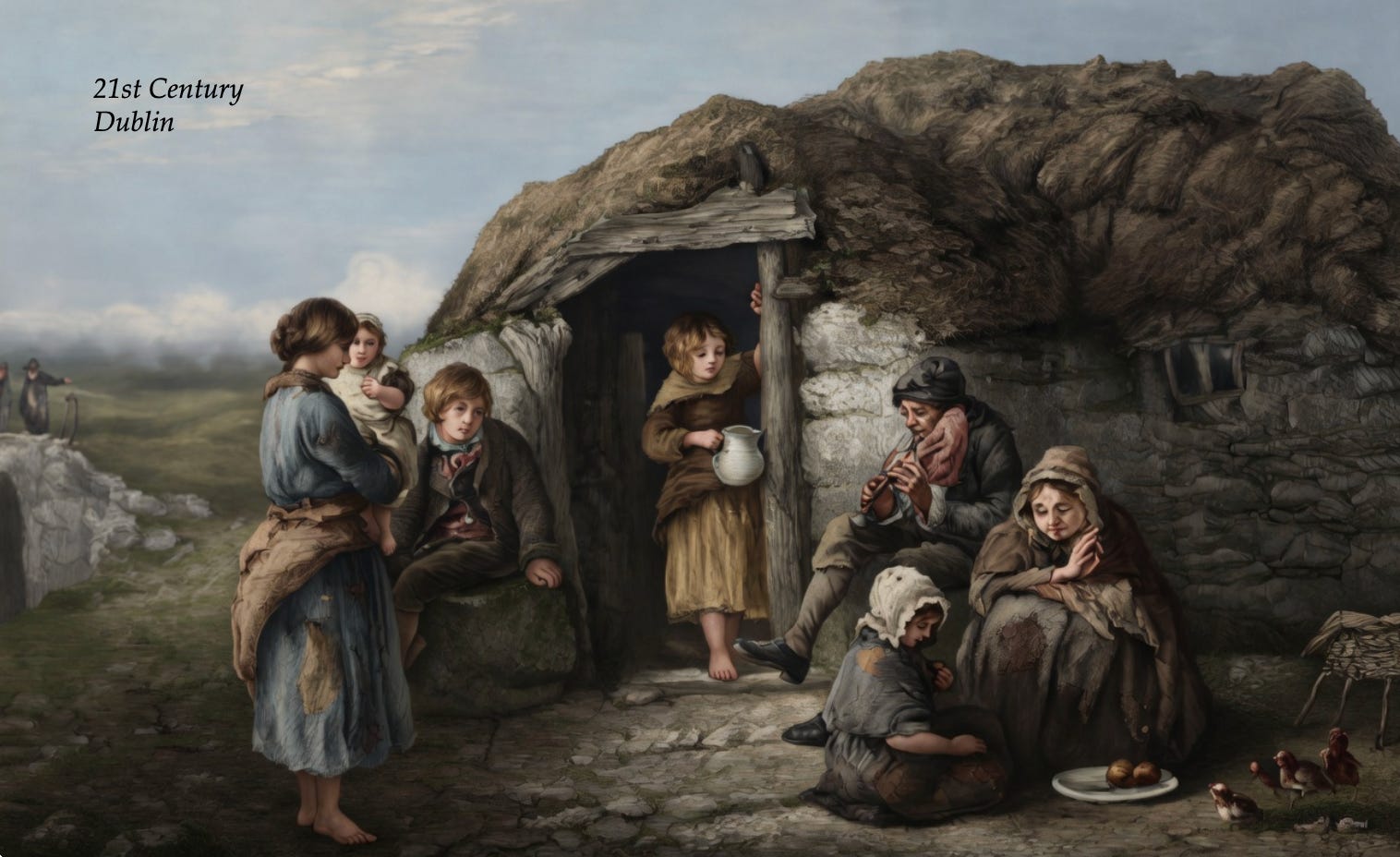
In America, you don’t have to worry about stagnation. You might simply stop. Your job can vanish overnight, no notice, no ceremony, your boss can fire you between bites of his third avocado toast because the quarterly numbers demanded a blood sacrifice and the immediate evaporation of your healthcare, along with your income. That’s just pure market poetry: you’re valuable until you’re not, at which point, enjoy the exciting new career path of “figuring it out before eviction.” Which it does, of course. In America, corporations are treated more like people. Not like you or I, with our inconvenient needs and organs, but better: immortal, tireless, and exquisitely protected. They do not get sick, they do not age, and they certainly do not require public healthcare or food stamps. Instead, they are free to accumulate, expand, and occasionally shed their human appendages when efficiency demands it. It’s a system of remarkable dynamism: the trapdoor beneath your feet is always well-oiled.
As for the minimum wage! Or rather, the thrilling absence of anything resembling a floor in large swathes of the service economy that the WSJ calls - a price floor that distorts labour-clearing mechanisms. I don’t know what that means exactly, but nothing builds character quite like working three jobs, sleeping four hours a night, and still qualifying for food stamps while your employer posts record profits. You hustle, you grind, while still paying off the interest on your student loans from 2004. That’s prosperity, baby. That’s trickle-down economics. In Europe, we have employment protections that prevent the sacred right to be ghosted by your livelihood. We even have the nerve to tax the wealthy at rates that might mildly inconvenience a hedge fund. All the while, Europe’s per-capita GDP stubbornly refuses to match the output of people who measure national success by how many politicians tech moguls can buy.
And then there is the Constitution, that visionary, beautifully written, sacred scrap of vellum from 1776, clutched to the American breast like the Shroud of Turin dipped in gun oil. A document penned by bewigged Virginia planters and slave owners who still thought lightning was a Benjamin Franklin parlour trick, something he did for laughs at dinner parties. That document is now treated as the literal, inerrant Word of a God who clearly favoured slave owners over people and, through feats of judicial divinity and alchemy that no medieval scholastic could match, that corporations have more rights than people, vast, soulless, immortal persons with an inalienable right to sluice unlimited cash into the Trumpian oligarchy, that some folk still insist on calling democracy. It is not a constitution anymore; it is a 250-year-old suicide pact written in the language of liberty, wrapped in a flag, and recited like a protective incantation against the modern terrors of affordable healthcare and employment rights. Where the theology of one-man - one-vote, do not have to compete with the vested interests of billionaires and gun lobbyists that are ok with children being murdered in schools, akin scenes that wouldn’t be out of place in civil war-ridden, sub-Saharan countries.
The USA cannot ban assault rifles, you see, because in 1776, militia men with muzzle-loading muskets thought a well-regulated militia might come in handy against future tyranny. How’s that working out against Trump and his attacks on the media and personal freedoms? The dead rule the living with the imperturbable tyranny of the unchanging. Meanwhile, over here in shabby, sclerotic Europe, forever being lectured on our moral poverty by some people whose idea of political philosophy is a bumper sticker, our laws tend to evolve. In Europe, we simply change the rules when the rules become irrational, chaotic, or dangerously absurd. We decided workers should not be chewed up and spat out. We decided, in moments of uncharacteristic lucidity, that the water coming out of the tap ought not to glow in the dark. We do these things because we are not chained by spectral plantation owners, not haunted by powdered wigs drifting through the halls of power like reproachful revenants. In Europe, we are allowed, however imperfectly, to be alive in our own era, so that legislation could be an act of collective self-defence instead of just another transaction in the great marketplace of political influence. How regressive of us. How déclassé we are in Europe for this political theology.
America, by contrast, prefers to be governed by its ancestors’ shopping list: a brittle - stained inventory of eighteenth-century neuroses, scratched out by a handful of bewigged Virginia planters and Massachusetts lawyers who genuinely believed they had nailed down the final, unalterable blueprint for human freedom before promptly going back to owning people. Even 250 years ago, a simply designed constitutional amuse-bouche for special interests. Plus ça change. And this, we are solemnly assured, without the merest flicker of irony or self-awareness, is freedom and liberty: the sacred and inalienable right to spend your entire life as a tenant in the crumbling intellectual boarding-house of dead men, powdered slave-owners, merchant princes, and provincial lawyers who thought they had solved the end of history once and for all. You may not redecorate. You may not move the furniture. You are forbidden, on pain of being called a tyrant or a liberty hater, even to notice that the roof needs new tiles, the wallpaper is peeling in long necrotic strips, and the foundations are quietly dissolving into the fetid corporate lobbyist swamp beneath. How very noble. How magnificently, heroically, asphyxiatingly free. Once your health insurance can cover the asphyxiation, of course. No one wants to die choking to death on liberty. Here in gloriously impoverished Europe, that would be considered quite uncouth.
The WSJ article warns that Europe’s welfare bliss will end when the money runs out. Fair enough. But perhaps the American model has its own collision coming, when enough people notice that being the richest country on paper doesn’t mean much if your “prosperity” is experienced as a constant low-level medical and financial terror, punctuated by thoughts and prayers from Republicans after the latest mass school shooting, who think the all too numerous deaths of innocent children at the hands of gun toting malcontents are the price of freedom. I genuinely do not understand how murdering children with guns gives you liberty and freedom? We have lots of liberty and freedom in Europe without our schools getting shot up.
Europeans may indeed register as marginally poorer on some bloodless GDP Excel spreadsheet, those glowing talismans of late stage-capitalist divination. When the body betrays us in its usual stupid, leaking, sickly way, we do not have to prostrate ourselves before the internet, palms outstretched, begging our colleagues who are one pink slip away from being unemployed also. The state steps in, empathy kicks in, and social welfare and healing are attempted by medical profesionals not avaricious financial institutions. That’s not stagnation or the word du jour among economists, stagflation. We do not have to crowdfund our continued existence like digital serfs rattling a metaphysical tin cup beneath the ambivalent gaze of strangers. We do not have to perform our suffering for shares on social media for GoFundMe transfers. How savagely Neanderthal of us.
Call it what you like about Europe: decline, decadence, managed poverty, demographic senescence, the slow euthanasia of old empires, whatever epithet flatters your flawed GDP spreadsheets this week. Some of us would still rather not live in a society whose highest purpose is the industrial manufacture of billionaires, a gleaming machine optimised to extract every last drop of blood, sweat and marrow from the many so that a vanishingly small number might own superyachts the size of small Irish towns.
Mississippi may indeed enjoy a higher nominal GDP per capita than Britain in the glittering fever-dreams of the Wall Street Journal’s Op-Ed section. Marvellous, deluded. And yet I will take the European model, imperfect, creaking, perpetually on the verge of fiscal infarction, over the sacred American right to declare bankruptcy because your child has leukaemia or got shot in school, to pass the hat among your neighbours so that the chemo might continue another round, to watch your life savings evaporate in the antiseptic waiting room of a for-profit hospital.
Keep clutching those highly deceptive little GDP-per-capita printouts, those sacred amulets of econometric voodoo, your trembling talismans raised against the unbearable stench of lived reality. We’ll be over here in Europe, in our still-breathing welfare states, quietly framing new laws so that a human being does not have to die in penury and shame for the unforgivable crime of falling ill, after their boss has already fired them for the even greater sin of not dragging their terminally-ravaged body into the office with sufficient neoliberal enthusiasm.
No GoFundMe campaigns. No choice between bankruptcy and burial. Just the dull, unglamorous machinery of civilisation trying, however imperfectly, to say: you are allowed to be sick without first being financially executed. How retrograde. How European. How almost obscenely humane.
Paul Krugman has an article out today also, that thoroughly debunks the now-infamous WSJ article and argues that it is actually the USA which is poorer. Don’t take my word for it. The man is a Nobel Prize-winning economist.

We also did a podcast on the WSJ article.

Best take-down of the USA Oligarchy I will ever see. Even tRump works overtime to wreck our lives in the U.S. He never sleeps. How to take-down the 3,000+ billionaires running the country is the question. The November midterm election is being rigged by Republican redistricting as we speak. Panic is waiting in the wings that fuel, energy grids, vital infrastructure, then water will dry up. Water filters are being hawked online "just in case" and "so that I can sleep at night". Yes, pathetic condition we find ourselves in.
I love that Paul Krugman has written a “What will Americans do when we realise we’re miserable” riposte 🤣