


Mar 3: “We won the war.”
Mar 7: “We defeated Iran.”
Mar 9: “We must attack Iran.”
Mar 9: “The war is ending almost completely, and very beautifully.”
Mar 11: “You never like to say too early you won. We won. In the first hour, it was over.”
Mar 12: “We did win, but we haven’t won completely yet.”
Mar 13: “We won the war.”
Mar 14: “Please help us.”
Mar 15: “If you don’t help us, I will certainly remember it.”
Mar 16: “Actually, we don’t need any help at all.”
Mar 16: “I was just testing to see who’s listening to me.”
Mar 16: “If NATO doesn’t help, they will suffer something very bad.”
Mar 17: “We neither need nor want NATO’s help.”
Mar 17: “I don’t need Congressional approval to withdraw from NATO.”
Mar 18: “Our allies must cooperate in reopening the Strait of Hormuz.”
Mar 19: “US allies need to get a grip - step up and help open the Strait of Hormuz.”
Mar 20: “NATO are cowards.”
Mar 21: “The Strait of Hormuz must be protected by the countries that use it. We don’t use it, we don’t need to open it.”
Mar 22: “This is the last time. I will give Iran 48 hours. Open the strait”
Mar 22: “Iran is Dead”
Mar 23: “We had very good and productive talks with Iran.”
Mar 24: “We’re making progress.”
Mar 25: “They gave us a present, and the present arrived today. And it was a very big present worth a tremendous amount of money. I’m not going to tell you what that present is, but it was a very significant prize.” Mar 26: “Make a deal, or we’ll just keep blowing them away.”
Mar 27: “We don’t have to be there for NATO.”
Mar 28: No major quote
Mar 29: Claimed talks were progressing
Mar 30: “Open the Strait of Hormuz immediately, or face devastating consequences.”
Mar 31: Claimed a deal was “very close” and that Iran would “do the right thing”
Apr 1: “We’ll see what happens very soon.”
Apr 2: Repeated that a deal was likely, while warning of continued strikes if not
Apr 3: “Something big is going to happen.”
Apr 4: Said Iran must comply “immediately” or face further consequences.
Apr 5: “Open the fuckin’ Strait, you crazy bastards, or you’ll be living in Hell - JUST WATCH! Praise be to Allah.”
There are modern political chronicles, the Cuban Missile Crisis, the Fall of Saigon, the Russian invasion of Ukraine, etched into history as a testament to statesmen navigating the chaos of war with solemn precision. And then there is the March Madness of Donald Trump’s Iran “victory tour,” a month-long seminar in verbal delusion where foreign policy became something of a stand-up routine, with every press conference contradicting the previous one. Trump’s statements did not form a timeline so much as a spiral. I spiralled with him.
“We won the war,” Trump said on March 3rd, as if the Middle East had momentarily agreed to his proposal. It was abrupt, miraculous, almost scriptural, America stumbling into glory not through bloodshed, battle or sacrifice, but through sheer assertion of Trump’s delusional maunderings.
By March 7, the victory acquired a name: Iran. “We defeated Iran,” he declared, with all the authority of a man describing what he had for breakfast yesterday. But then came March 9, and suddenly, the war needed to start again. “We must attack Iran,” he demanded, undoing his own triumph, as if declaring some sort of victory were an engine that required constant fuel. Later that same day, he told the world, “The war is ending almost completely, and very beautifully,” a phrase that shimmered like a narcotic-induced hallucination. One imagines Pentagon officials, whiplashed and glassy-eyed, trying to translate the President’s wormhole of logic into an actionable memo.
By March 11, victory had been achieved “in the first hour,” but humility forbade him from saying so “too early.” Victory deferred, delayed, upcycled, recycled, whatever youre having yourself. March 12 brought semantic confusion: “We did win, but we haven’t won completely yet”. The same contradiction was rendered unholy by the theology of his own uncertainty. March 13: another victory announced; March 14: “Please help us.” America, like a gambler on the verge of ruin, is alternately triumphant and destitute, and asking for help from former friends.
By March 15, gratitude curdled into warning, If you don’t help us, I will certainly remember it. The President’s diplomacy took on the logic of an urban legend. March 16: “We don’t need any help.” Then, minutes later, a confession, “I was just testing to see who’s listening.” Then threats again: “If NATO doesn’t help, they will suffer something very bad.” The words had melted and reformed into a doom loop, every pronouncement somehow worse than the last. It was not a coherent language being spoken, but a language speaking itself. Like some ancient forgotten vernacular no one understood.
By St Patricks’s Day, Trump announced: “We neither need nor want NATO’s help,” and then, impossibly, “I don’t need Congressional approval to withdraw from NATO.” Turns out he does. Foreign policy dissolved into solipsism: there was only his will, bouncing off the marble walls of his own rhetoric. Watching in stupidfied amazement, I was starting to wonder whether he was going to take credit for banishing the snakes from Ireland.
The Strait of Hormuz has become the stage upon which his solipsism played out. On March 18: “Our allies must cooperate in reopening it.” March 19: “US allies need to get a grip.” March 20: “NATO are cowards.” March 21: “We don’t need to open it.” A week later, no one knew whether the Strait existed at all, whether it had evaporated under the sheer friction of his contradictions.
March 22: “This is the last time. I will give Iran 48 hours.” Two breaths later: “Iran is Dead.” It was poetry of annihilation, not description but incantation, a man inventing death and destruction as a tool for emphasis.
On March 23, death became negotiation: “We had very good and productive talks.” A day later, “We’re making progress.” By March 25, the apocalypse had been monetised: “They gave us a present … worth a tremendous amount of money.” It was all happening at once: conquest, collapse, rebirth, sale. The war became a biblical shopping channel, where nations and souls were interchangeable goods. My own sanity was beginning to fray at this stage.
By March 26, he oscillated between negotiation and threat: “Make a deal, or we’ll keep blowing them away.” March 27: “We don’t have to be there for NATO.” The empire untethered. On March 29, progress again, illusory peace. But by March 30, the prophecy returned: “Open the Strait immediately, or face devastating consequences.” “Taco Trump”, the Iranian regime openly mocks Trump on social media via the medium of A.I. generated Lego movies. For the times we live in, diplomacy is the velvet glove that cloaks the fist of power on social media.
Every utterance was a new creation myth. Trump spoke, and reality flickered accordingly. Journalists tried to catalogue his statements, unaware that the act of listing them had created a parallel timeline, another dimension, a phantom republic existing somewhere between war, peace and delusions. March 31, he whispered about a “deal that is very close.” April 1, “We’ll see what happens very soon,” a mantra for the waiting room of geo-politics. April 2, optimism and threat fused again, a “likely deal,” plus “continued strikes if not.” I have one thing in common with Trump: watching all this, my sanity has also abandoned me.
April 3: “Something big is going to happen.” The words glowed with anticipation but contained nothing. April 4: “Iran must comply immediately.” And then the grand descent, April 5: Profanity as divine revelation:
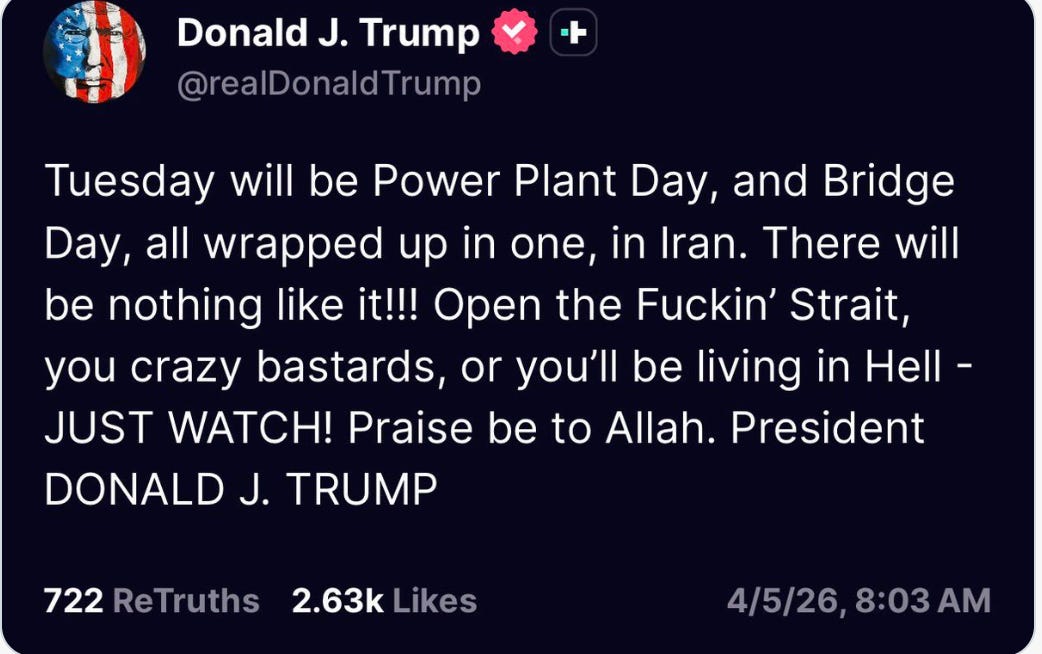
Perhaps, by then, his language had simply exhausted itself. Beneath the mask of rage was pure delusion, a man so entangled in his performance that a prayer and a murderous threat emerged in the same breath, indistinguishable. Surely he’s reaching the theological endpoint of his grandiose proclamations? Allies and enemies floating through his sentences like debris in orbit, rearranged at will. War was not a thing that happened, but a linguistic event, created, deleted, rebooted, all shouted into microphones while the world watches in astonishment. By this point, I’ve become my own apothecary, grinding down the days into liquids and draughts, administering them at regular intervals, pretending it’s treatment and not just another exquisite form of surrender to Trump’s aberrations. It almost reminds me of the great 2008 crash and Irish politicians making grand pronouncements about solvency when, as a country, we didn’t have two coppers in our back pocket. Political delusion isn’t some exotic American disease. Every parliament and palace is a sanatorium, every minister nursing their own carefully prescribed hallucination, convinced that history blinks only for them. Deluded American politicians have nukes, though
By April 5, things Trump has said have long stopped making sense. Perhaps this is what empire looks like at the end, the sovereign as oracle, babbling imagined victories. The absurdity isn’t just his contradictions; it’s the way the contradictions form their own theology, their own shimmering truth. He wasn’t getting facts wrong; he was inventing facts from scratch, waging war not just in Iran, but on the stability of the present tense.
Iran lived and died and lived again, NATO alternately harangued, betrayed and ignored, the Strait opened and closed like an eyelid. Each proclamation devoured the one before it. The journalists who transcribed it have become theologians without even realising it, recording the steady unravelling of an empire driven by one man’s psychotomimetic behaviours. Front row seats to the end of an empire and possibly humanity as we know it. What a time to be alive!
The absurdity here is not merely rhetorical. It is operational. If the President does not know whether the U.S. has won, needs help, wants NATO, uses the strait, or is talking or not talking to Iran, then no adversary fears the threats, no ally trusts the pleas, and no journalist understands the policy. Some will argue this is strategic chaos, 4D chess or the like, keeping adversaries off balance. But chaos without consistency is not strategy; it is just noise. A country cannot ally with, threaten, ignore, beg, and praise the God of an enemy it has declared “dead” within the same month without eroding every instrument of statecraft.
And perhaps, in some Trumpian galaxy-brained sense, he really did win the war, not against Iran, but against the tyranny of rationality itself.
I’ve no idea how you managed to keep Trumps announcements in order - not that the order makes any sense.
I am just totally flummoxed by the lack of national and UN condemnation of Trump’s threatening intentions. He is proposing war crime of an extreme level.
The country & its bedfellow/boss - Isreal should both be heavily sanctioned by the rest of the world.
It’s pure madness living in the USA. The mania is turning the world upside-down….in the worst possible way. 💙🗽☮️