
The Phoenix is Dead
Social media killed it.

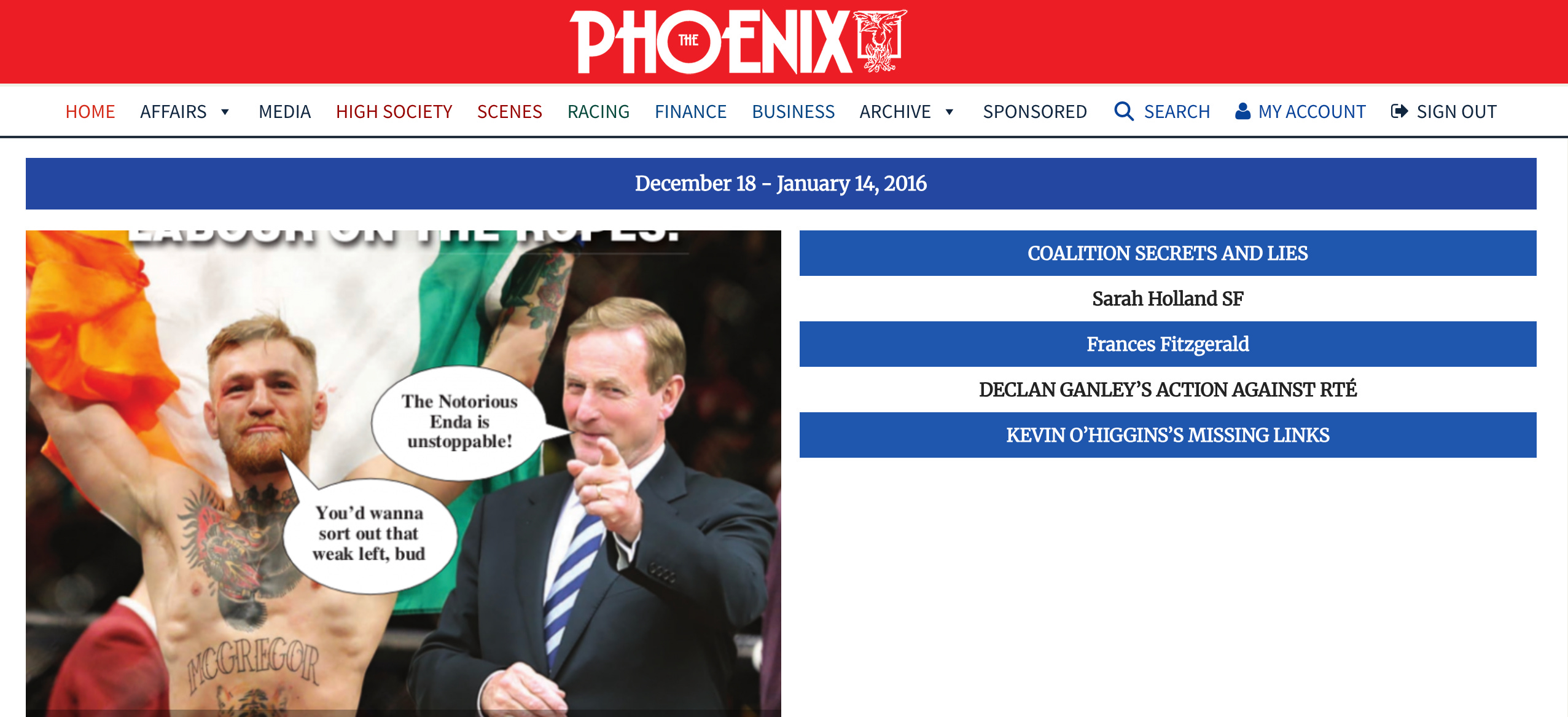
It has come to this. After forty-three years of sly, scabrous fortnightly dispatches, those smudged, ink-stained missives from the underbelly of Irish power, half Private Eye, half something older and more venomous, not very intellectual, the Irish politics and finance Phoenix Magazine is closing. No more issues. Voluntary liquidation, they say. The printers will fall silent, the newsagents’ shelves will yawn a little wider, and somewhere in a small circle of political and business readers will feel the peculiar ache of something irreplaceable slipping into the archives of Irish history. Paddy Prendeville’s sharp tongue has been silenced at last, much to the relief of a much older generation who remembers the gossip peddled and the damage done by that gossip. The beast that gorged on politicians’ and other sacred cows’ secrets and spat them back in cartoon form is finally, mercifully retired. They had embarrassed themselves too often in recent years. It was time for The Phoenix to go, much like a boyfriend or girlfriend you still love dearly, but can no longer stand being around. The relationship had run its course. What once felt exciting, vital, and even a little dangerous had become less fashion-conscious, outdated and increasingly irrelevant in a faster, louder world. You might miss the good times and feel a pang of nostalgia, but deep down you know the kindest thing - for everyone - is to walk away.
And yet one feels the urge to laugh, or at least allow oneself a wry grin. Because this is not a tragedy. This was something quite ineluctable. The Phoenix did not fall because of some unique Irish misfortune or editorial misstep (although there were a lot of pro-Russian articles in recent years, which didn’t help); it fell because it was made of paper in a world that has decided paper is an indulgence. A relic. The corpse of a medium that once carried the weight of revelation but now only carries the weight of itself in the form of digital usage on your phone. This is the very modern but old tragedy of a minor Irish magazine. It begins with a belief that if the writing is good enough, the truth sharp enough, the readers intelligent enough, then the money will somehow materialise from the atmosphere like rain. It rarely does. What appears instead is the digital world: infinite, ravenous, impatient, and full of clickbait. Why pay for, in this case, a bi-monthly physical object when you can have the whole collapsing geo-political carnival in your pocket, updated by the second, that feeds your attention span deficit like a wasp on cocaine.
Consider the economics, the accountants say, those bland but merciless financial gods. Ink, pulp, distribution vans wheezing through the Irish rain, the whole creaking apparatus of getting printed atoms from one place to another so that eyes might pass over them in the correct order. These costs do not bend to sentiment. Meanwhile, the readers, especially the young, the terminally online creatures who were never really the Phoenix’s core anyway, have long since migrated to the glowing rectangle in their pocket, where scandal arrives faster than scandal can even happen. Why wait a fortnight for the next instalment of Goldhawk’s gossip when the leaks, the threads, the furious quote-tweets are already coagulating in real time? The internet does not publish every two weeks. It publishes constantly, breathlessly, in the manner of a hysterical teenager that has learned how to monetise itself.
There is something almost systematic and rational in this shift. Print demanded a ritual: the trip to the shop, the rustle of pages, the faint smell of newsprint that clung to your fingers like a guilty secret. Digital demands nothing except attention, and even that it extracts with the cold efficiency of a tax collector who has studied behavioural psychology. The Phoenix Magazine tried, late and half-heartedly, to cross over. A website. Some PDFs, perhaps. But it was always too little, too late, like watching those big beasts of Irish Politics in the 1990s and early 00’s trying also to get to grips with the advent of social media. A lot of those politicians could not adapt and similarly and were never heard of again.
There is much to lament about the passing of The Phoenix Magazine; it was once a publication to be feared. You’d lick your lips and break into a wolf-like grin while muttering something about little piggies at the sight of the cover. That thrill stopped around the coming of social media. You see, the Phoenix was ultimately a political and business gossip magazine. Social media killed niche print publications that relied heavily on gossip. Anyone with a smartphone or insider access can post documents, voice notes, videos or tips instantly. A backbench TD’s gaffe, a dodgy planning permission, or an executive’s raunchy email lands on X or Facebook before a magazine can typeset it. Social media destroyed The Phoenix’s core advantage by removing the need for gatekeepers entirely. In the old model, an insider with damaging information had limited options: leak it anonymously to a trusted editor at The Phoenix (or similar outlets), hope they verified and published it, and wait for the publication to drop. That gave the magazine power; it controlled the flow, the timing, and the credibility. Today? None of that is necessary.
And here we arrive at the deeper horror. The digital world did not merely outcompete print; it revealed print’s hidden dependence on scarcity, on delay, on the physical limitations that once gave writing its gravity. Now everything is abundant, instantaneous, weightless. Meaning itself begins to feel weightless. The Phoenix’s investigations, its barbs, its carefully hoarded scoops, once they had the force of something that had crossed distance and cost money to reach you. Now the same information (or better, or worse, or simply more) arrives whether you want it or not, in an avalanche that buries discernment.
We are left, then, with the familiar late-capitalist paradox: an explosion of voices accompanied by a slow suffocation of anything that cannot be scaled, optimised, or fed into the engagement algorithm. The niche that once sustained itself in the cracks of the old media ecology finds those cracks paved over with smooth, infinite feed. Small print publications will not survive—not because people no longer crave sharp, irreverent, dangerous writing, but because the material conditions for that writing to exist as a coherent thing in the world have been abolished.
The phoenix, in myth, rises from its own ashes. This one will not. Its ashes will simply blow away, mingling with the particulate matter of a billion discarded hot takes. And in their place we will have... what? More noise. More speed. More of the same. The medium was never neutral, and now the medium has won. It always does. So no, small niche print publications will not all survive in a digital world. A few will linger, embalmed by prestige or subsidised by government. Others will die with some form of dignity, which is still dying, says you. The rest will be remembered the way one remembers old radical pamphlets or extinct newspapers: as evidence that, for a moment, someone believed the printed page could still hold the line against history. The Phoenix didn’t stand a chance, and in this attention-driven economy, no one will care next week.
The latest episode of The Atlantic Current is now available. We talked about the pogrom attempt in Belfast last week.
Apple Link
Spotify Link
This is very sad 😢