

The Aughinish Alumina Review Leaves the Obvious Unanswered
We investigated ourselves and found nothing school of Irish Politics.

The independent review into the exports of the Aughinish Alumina plant in County Limerick, released yesterday, we are assured, has produced no “adverse findings.” Minister for Enterprise Peter Burke has duly passed this document of carefully curated emptiness to the European Commission, as one might hand a particularly bland Christmas present to a distant relative, or a boring relative you rarely see. The Taoiseach himself has confirmed that there exists no definitive proof that alumina from the Aughinish facility is finding its way into the furnaces of Russian weapons manufacturers. There is also, with the exquisite convenience of no definitive proof that it is not either. And so the matter settles, like dust in a room no one intends to clean, into that peculiar bureaucratic twilight where the absence of evidence is treated as a kind of evidence itself, and everyone may go home feeling both reassured and vaguely complicit.
Forgive the raised eyebrow; it is, after all, my only organ still capable of independent motion while watching this affair unfold. The plant belongs to Rusal, that great Russian aluminium behemoth whose ultimate proprietor is Oleg Deripaska, one of the most sanctioned men in the world, a man whose name alone seems to arrive already sheathed in deniability. Alumina, for those who have forgotten the periodic table’s more mercenary chapters, is the indispensable material without which aluminium cannot be conjured into existence. Russia has laboured under a comprehensive lattice of sanctions ever since it decided, in 2022, that Ukraine required a more vigorous form of neighbourly attention. And yet the official Irish position collapses, with the elegance of a house of cards assembled by a Dáil committee, into the following doctrine: we cannot possibly know where the stuff disappears to once it crosses the Russian frontier, because Russia declines to publish any internal trade data that a reasonable person might call usable, while the company itself merely asserts, politely, firmly, as might asserts that the current bout of mediterranian like Irish weather is grand, that none of its product wanders into the military supply chain. This assertion, the department concedes with the weary candour of a priest admitting the Eucharist is only bread, “cannot be independently verified.” And so the circle closes: the absence of proof becomes the proof of absence, and everyone is free to look elsewhere for some moral guidance.
How is anyone expected to accept, with a straight face and the full solemnity of an adult who still believes in the competence of governments, that this raw material is somehow, by some quiet miracle of logistics and Irish goodwill, remaining chastely outside Russian military channels? The investigating journalists whose reports first stirred the bureaucratic hornet’s nest could not, for all their brilliant journalism, track the final destination of any single batch; the trail simply dissolved, as trails tend to do when they approach the borders of a war-mongering Russia that has decided opacity is a strategic virtue. The people who compiled the report consulted Sweden, Ukraine, various other bodies, and, of course, the company itself (stop laughing spooks) and reported that they had found no corroborating evidence for the media’s more inconvenient claims. Yet again, the absence of evidence is not evidence of absence - particularly when the country in question possesses every conceivable incentive to obscure its wartime industrial supply lines and has, with admirable thoroughness, sealed off the very data vector that might allow anyone to check. And so the official silence settles once more, like a polite, inconvenient fog, over the whole affair, sorry for interrupting your war crimes, Russia.
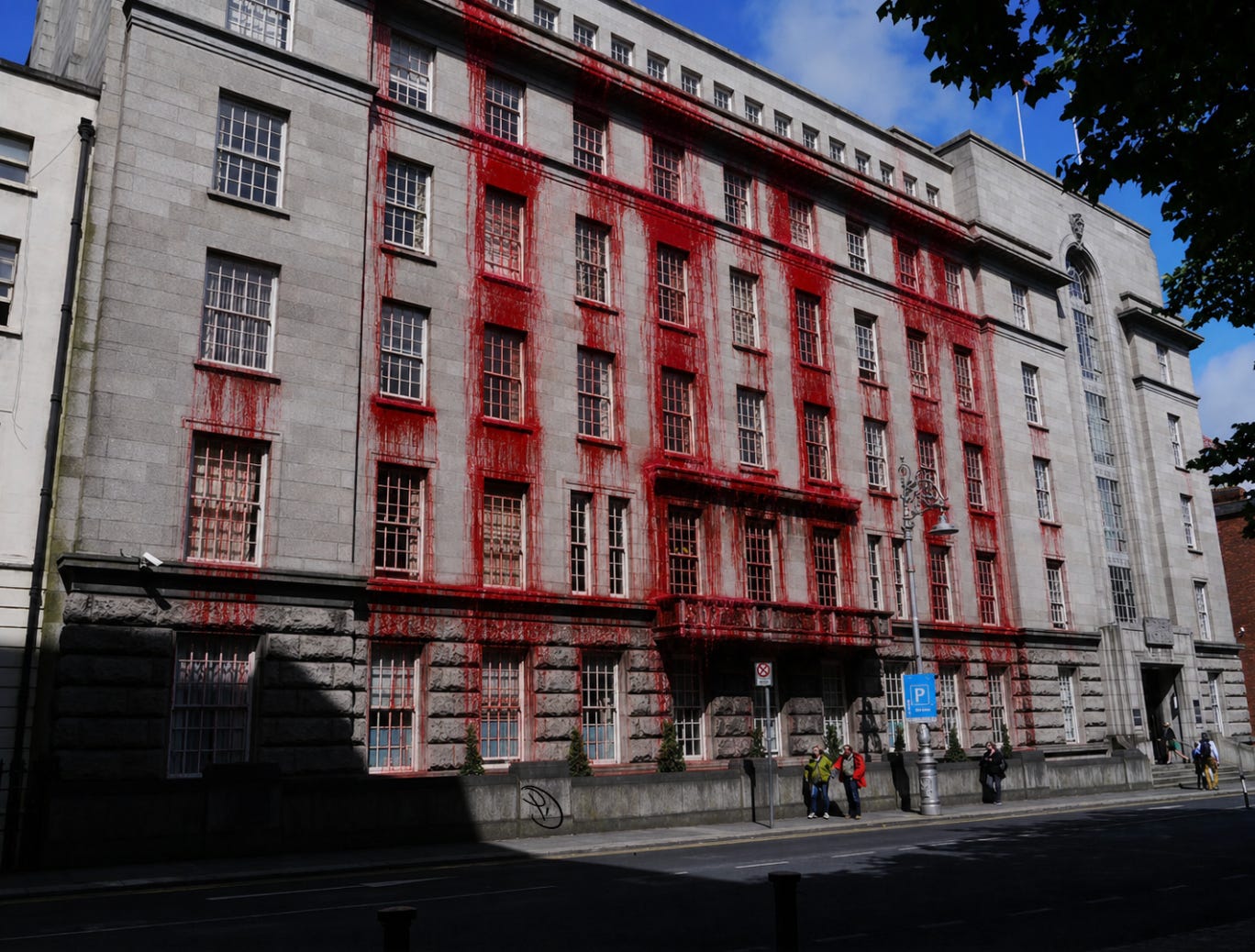
The deeper absurdity is the whole investigation itself. Minister Burke’s department has done what it can from outside: gathered statements, engaged partners, and reviewed open sources. Yet the decisive arena is inside Russia. How does one investigate the internal destination of alumina shipments when the Russian state will not allow independent verification, has restricted trade statistics since 2022, and treats military-industrial flows as state secrets? The minister himself acknowledges the “lack of verifiable internal trade data within Russia.” In other words, the inquiry was constrained from the outset by the very opacity it was supposed to pierce.
Ludicrously, ownership questions were, with the exquisite delicacy of a diplomat removing a fly from the soup, deliberately set aside; the focus remained narrowly, almost monastically, on whether alumina was leaking into the Russian military complex. A recent Swedish taxation judgment suggests that Oleg Deripaska still exercises majority control over Rusals alumnia plants in Europe. Deripaska is also sanctioned by the USA, EU, Australia, Canada, New Zealand, Switzerland, and others, generally under Russia/Ukraine-related frameworks imposed or expanded after the 2022 invasion. The global sanctions against Deripaska arise, in the first instance, from his proximity to the Russian state and Vladimir Putin, his comfortable berth in the energy sector, and as Putin’s favourite Nazgûl. He is also accused of an iteration of alleged corrupt and criminal conduct that first attracted official notice in the context of Russia’s earlier war crimes in Ukraine. After February 2022, the measures imposed by the European Union, the United Kingdom and various others shifted their emphasis, treating him as a prominent oligarch whose business empire, particularly the aluminium and related sectors, serves to support or at the very least substantially benefit the fascist Russian government during its full-scale war against Ukraine. The underlying purpose of these sanctions is the familiar one: to apply pressure upon the regime by targeting the elites who cluster nearest to its centre of political gravity, thereby restricting their access to Western finance, markets and the softer amenities of Western liberal democracy they claim to despise. But does anyone inside the Department of Enterprise and Trade not find it even remotely incredible, does no eyebrow so much as twitch?, that a man sanctioned for his role in aiding and abetting Russian war crimes is permitted, with the full bureaucratic blessing of the Irish state, to operate and own a facility that manufactures materials for the Russian war machine, all within Ireland’s own jurisdiction?
Excruciatingly for Peter Burke, the unlucky Minister left holding the can for this report, he explained on RTE radio, with the bureaucratic detachment of a man describing the weather, that the reason Irish alumina exports to Russia doubled after the invasion was simply this: European companies, suddenly alive to the delicate matter of ‘reputational “damage, refused to continue doing business with Aughinish. The material, finding itself unwelcome in more fastidious markets, had nowhere else to go but to Russia, where, conveniently, the demand in a wartime economy remained robust and the moral arithmetic less publicly performed.
The Irish Government assures us it will continue to monitor the situation and will act upon any future verifiable information that may one day present itself. The Irish Government stands, we are told, “in lockstep with Ukraine.” The Government is fond of pointing out, with the quiet pride of a nation that has done its bit, that Ireland has taken in some 121,000 Ukrainian refugees. It is a generous figure, and no doubt sincerely meant. One cannot help wondering, however, whether fewer of those refugees might have needed to cross half a continent if the same jurisdiction were not, through the continued export of materials that find their way into the Russian war effort, helping to furnish the very machinery that displaces so many civilians in the first place.
These statements of solidarity with Ukraine by the Irish government are, of course, welcome; one would hardly expect less from a Western democracy. They do not, however, dissolve the central difficulty that has haunted the premise of this report from the beginning. When the destination country refuses all scrutiny, when the relevant trade data has simply doesn't exist and when the sole counter-claim on offer is an unverifiable Russian corporate assurance whispered from behind closed borders, the solemn insistence that nothing adverse has been found begins to sound less like the product of rigorous investigation and more like a polite acknowledgement of the limits of what can ever be known from the outside. Proving a negative under such conditions is not an investigation at all; it is an exercise in the carefully cultivated hypocrisy, because how can Ireland sanction Israel while it turns the other cheek and sends the raw materials to Russia to feed its war machine?
Any claim that Aughinish alumina is cleanly ring-fenced for civilian export aluminium is not demonstrated by facts but as an article of faith, the sort of quiet theological assertion and mental gymnastics that allows the politicians to sleep at night while the material itself continues to be shipped to Russiasia, somewhere beyond the reach of verification, to do whatever it is that alumina does.
The latest episode of The Atlantic Current is out.
We discuss the yawn heard around Europe in relation to Aughinish.
This is Jesuitical reasoning taken to its extreme, casuistry in a contemporary context by the Irish Government.
Why ministers think anyone is fooled by this Alice in Wonderland logic is the real mystery?
‘Why, sometimes I've believed as many as six impossible things before breakfast’
Have you thought through the implications of seizing control of the plant? What's your plan for securing the faculties against an inevitable Russian-backed attack down the road?
How many armed resources do we need to put in harms way? Is it even possible at this stage to reliably shoot down drones launched from ships on the Atlantic? We won't have air defense fully deployed until next year. We don't get our military radar until 2028.How do we even detect drones without that?
These things are never as straightforward as they are made out to be. Unless there's concrete evidence and other European countries agree that it should be taken over, the best course of action is to do nothing and wait.
We don't live in a black and white world. We never have. You should know this. Maybe a little bit of forethought might not go astray.