

RUSSIA WARNS IRELAND — FOR THE EIGHTH TIME
Most serious consequences!

There is, in the way the Russian Ambassador, Yury Filatov, threatens Ireland, something almost soap-operatic about it, a will-he-won't-he quality, a slow-burn tension you'd expect from two neighbours on the cul-de-sac rather than two states with a treaty relationship. It isn't the old Cold War bombast, all nuclear winter and tank divisions grinding across the North German Plain on their unlikely way to Dunmanway; that kind of threat at least had the decency to be enormous, to gesture at continents and megatons, to mean the whole world when it meant anything. What Filatov does is smaller and stranger and somehow worse for it, a pastoral menace, delivered at the volume of a man adjusting his spectacles over a garden fence, mentioning, almost in passing, that the neighbour's dog has been at the flowerbeds again, and that next time there might have to be consequences. For the dog, presumably. Or perhaps for the neighbour. Or possibly, in some sense, the sentence itself declines to specify, for the flowerbeds - it's never quite clear who the consequences are actually aimed at, and that ambiguity is not a flaw in the delivery, that is the whole point of the delivery. The threat works by refusing to resolve into something more corporeal. You are left standing at your own fence, holding your own dog, wondering which of you he meant, and it is precisely that wondering - small, itchy, undignified - that constitutes the whole transaction. Nobody has been threatened. Somebody has simply been made, ever so slightly, to feel the weather changing.
The diplomatic tête-à-tête began, properly speaking, in March 2018. Britain had just accused Russia of attempting to murder Sergei Skripal with a nerve agent on the streets of Salisbury. Ireland, in a rare display of continental solidarity, expelled a single Russian diplomat. Filatov emerged from the Department of Foreign Affairs looking like a man who had been offered a pint of zero alcohol Guinness. The decision, he announced, was “unwarranted, uncalled for, senseless and regrettable.” More importantly, “this type of unwarranted action will absolutely not go unanswered.” It was the first clear sounding of the theme that would define his never-ending tenure: the quiet, bureaucratic promise that somewhere, in some Russian diplomatic ledger, a mark had been made against Ireland’s name.
Four years later, the tone had not changed so much as it had matured, like a fine, slightly poisonous wine.
West Cork men do not merely live in the Rebel County. They are the county, distilled, bottled, and left to ferment in a damp harbour bar until somebody tries to tell them what to do. And in January 2022, somebody did. The Russians, with their usual gift for subtlety, announced they would be holding live-fire naval exercises right on top of the best fishing grounds off the southwest coast of Ireland. The Russians would practice with artillery, rockets, and all manner of potentially fishing ship-sinking weaponry. The whole show. About 150 miles out, technically international waters, but deep inside Ireland’s exclusive economic zone, where West Cork trawlermen have been pulling fish out of the Atlantic since before Moscow was a collection of wooden huts around a muddy river. The Irish South and West Fish Producers Organisation did what any self-respecting group of (mostly) Rebel County men would do when a foreign navy shows up and starts waving guns over their livelihood: they announced they would keep fishing anyway. Peaceful protest, they called it. Which, in West Cork, is roughly the same thing as a declaration of war delivered with a shrug, a smoke and a pint Murphy’s, while muttering under breath about Kremlin langers. So Ambassador Yury Filatov invited the fishermen to the Russian embassy in Dublin for a little chat. One can only imagine the scene: Filatov, a career diplomat who has spent a lifetime explaining unpleasant realities in the careful language of Kremlin passive-aggressiveness, sitting across from a couple of hard-handed men from Castletownbere who look like they could arm-wrestle a Russian submarine and win. The ambassador listened to their concerns about ruined nets and dead fish and then, with the grave patience of a man who has had to explain the concept of Kremlin “consequences” to many stubborn audiences before, urged them to “refrain from any provocative actions which might endanger all involved.” Provocative actions. In West Cork? That phrase covers everything from parking on a double yellow line to sailing a trawler through a Russian live missile exercise while giving the finger to the commander of the Russian fleet. The fishermen left the meeting claiming they’d gotten some kind of understanding. The embassy later denied any such thing and repeated the “consequences” warning. A few days later, Moscow quietly moved the drills farther out to sea, citing a “gesture of goodwill.” Gesture of goodwill? That was the sound of a nuclear-armed superpower deciding it did not, in fact, want a fight with a few dozen West Cork skippers who had already made it clear they were perfectly willing to die stupidly for the principle of not being told where they could fish. Rebel County did what Rebel County has always done. It looked at a large, heavily armed opponent making serious noises and replied, in effect: “Ah, go on, ya will ya,” and the large, heavily armed Russians blinked first. Not the first empire to become unstuck in West Cork.
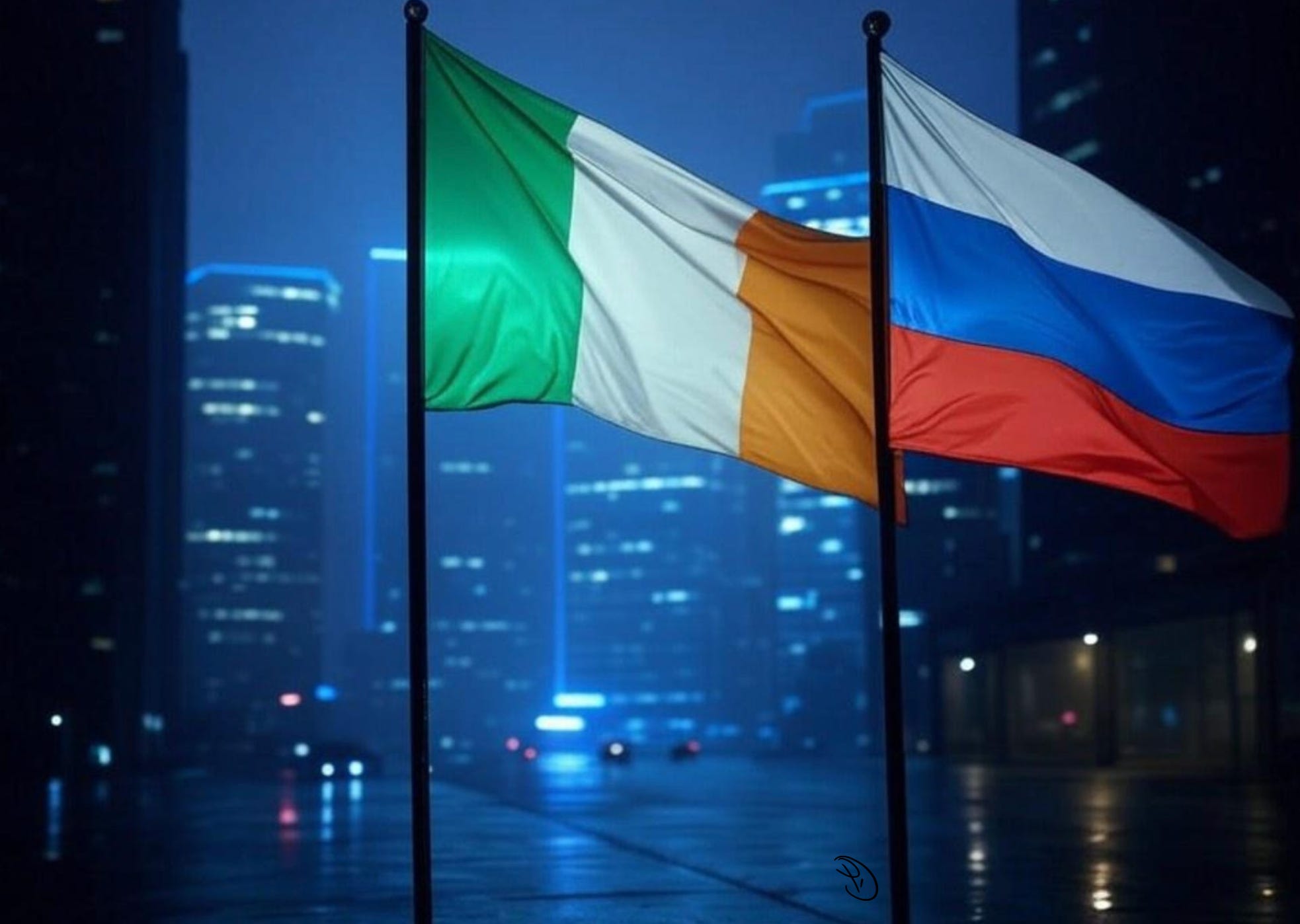
In late March 2022, Ireland performed one of those small, almost unsual acts of sovereignty that neutral countries reserve for moments when the world has become too dangerous even for cosplaying neutral countries: four Russian diplomats were packed off, their visas quietly cancelled, their “undeclared diplomatic hobbies”, the usual mixture of signal-gathering, influence-peddling, dropping the hand on broke influencers and whatever else one does under the polite fiction of cultural attaché, their activites were finally judged incompatible with Ireland’s soverign patience. The embassy responded with the particular Russian gruel of official grievance. The decision, it announced, “would not go unanswered.” A few weeks later, the note was refined, polished, and given a more elegant threat: should Ireland continue its “destructive line towards Russia,” Moscow was determined to respond “proportionally to any hostile steps.” Proportionality. In the Russian diplomatic lexicon, the word is less a measurement than whatever mood Putin is in, a kind of metaphysical elasticity. It stretches and contracts according to Putin’s whims. It is the language of a power that has learned to speak in the conquering voice of history, promising consequences that are never quite specified, only inevitable, like the Irish weather, or debt, or the slow return of a thing one has tried to forget.
By April 2023, the tone had sharpened. An Irishman named Finbar Cafferkey had been killed fighting the Russians near Bakhmut, and Irish politicians, never ones to miss an opportunity for principled grief, had called him a man of principle. The Russian ambassador observed that if such remarks indicated official encouragement for Irish citizens to join in the war on the side of Ukraine, then Ireland would become “the direct participant of the conflict with all the ensuing consequences.” The phrase “ensuing consequences” has a kind of bureaucratic finality to it, but what it really means is that because the consequences are unnamed, the threatened country is left to imagine the worst: sanctions, cyber attacks, diplomatic retaliation, intelligence operations, economic pressure, or something more kinetic. Fear of the unknown is often more effective than a specific threat.
And then in May 2024, it was the frozen assets' turn. Europe had worked out that it could take the money, the actual money, sitting there in European banks, belonging in some legal-fictional sense to the Russian state, and hand it over to Ukraine, to help pay for the war that Russia was still, at that point, busy denying it had started. And Ambassador Filatov, entirely straight-faced, apparently untroubled by the fact that his own country was in the process of trying to annex a chunk of Eastern Europe roughly the size of several small nations, declared Ireland an "accomplice in an outright theft." It is a remarkable sentence, if you sit with it long enough - the word "theft" being deployed by a man whose government's entire foreign policy consists of drawing new borders on other people's maps and calling it history. He promised that the response would be “inevitable,” and that it would "come in the form that best suits Russia's interests," which is one of those phrases that manages to sound like a threat and a shrug at the same time, a kind of diplomatic Schrödinger's box, containing both an army and absolutely nothing, until such time as Moscow decides which one it would prefer you to find. This is the whole performance: the theft is always what happens to Russia, never what Russia does to anyone else, and the inevitability is always aimed outward, at the smaller party, who is asked to sit and wait and wonder what form, exactly, Russia's interests are going to take this time, while the actual theft, the tanks-and-borders kind, carries on next door, entirely un-ironically, under a different name.
Then, in June 2025, the full flowering of the style: the “day of reckoning.” Supporting Ukraine, the ambassador explained, made Western governments, Ireland included, “de facto accomplices” in “barbaric terrorist acts.” They should be aware that the day of reckoning would “inevitably come.” When asked what exactly this meant, an embassy spokeswoman replied that the remarks were “pretty much self-explanatory.” It is the perfect Filatov sentence, ominous, content-free, and somehow he appears faintly irritated that you needed it explained.
By February 2026, the issue had become maritime again. Minister Helen McEntee floated the idea of boarding Russian “shadow fleet” tankers. Filatov detected, with his usual hypersensitivity, the stench of piracy. Such actions, he warned, would carry “the most serious consequences.” In August, as the relevant legislation advanced, he repeated the point more firmly: the Irish had been warned. Attempts at such “acts of piracy” would have “the most serious consequences for them.” If I were Minister McEntee, I’d just let the West Cork fishermen deal with the Russian navy. Give them some sort of seal of state and call them Privateers.
Again, this week: the same fairly technical piece of legislation, still making its slow way through the Dáil, an amendment to the Defence Act that would let the Navy board certain vessels, check their papers, tell them where they may and may not go. And again, like the drunk at the end of the bar who has been asked to leave four times and keeps reappearing by the door with some fresh, unwanted thing to say, Filatov had a comment. This is, by now, less a diplomatic exchange than a piece of weather, something that simply recurs, on schedule, whether or not anyone in the room wants it to — the geopolitical equivalent of a man who mistakes being ignored for being invited to stay. Nobody asked him back. He came anyway. He always does.
Filatov again called the proposed law a sign that Ireland was ready to join in what he described as “pirate actions” already being carried out by bigger powers against ships trying to dodge sanctions. He said Ireland had already been warned. If the country went ahead with these boarding powers, he said, it wouldn’t just draw a diplomatic complaint, it would bring “the most serious consequences.” It’s a phrase Russian officials use a lot, and it’s vague on purpose: not a list of specific threats, just a warning that things, once set in motion, tend to escalate on their own. One outlet covering the story overstated things a bit, reporting the law as already passed when it was still just a bill, and noted, accurately, this time, that Ireland’s small patrol fleet would probably need help from the British or French navies if it ever actually tried to board anything. Once again, making a mockery of Ireland’s supposed neutrality.
Meanwhile, the Minister for Foreign Affairs kept doing what ministers for foreign affairs do, which is speak in the special dialect reserved for people who have to describe violence without using the word: gaps in the law, threats at sea, a framework, always a framework, as if the ocean were a piece of flat-pack furniture missing a screw. Everything she said was, naturally, fully consistent with international law, because everything anyone says before they do something is fully consistent with international law; this is what international law is for. And on the other side, across an ocean this bill hadn't even started to police yet, the man in the Russian embassy kept using the other special dialect, the one where every sentence is a small closed fist, where '‘consequences” doesn't mean anything becuase it doesn't need to mean anything - that's the whole trick of it, the threat that stays sharp precisely because it refuses to become a fact. Two people, in effect, standing in the same metaphorical room, each speaking opaque diplomatic language, neither once making eye contact. This is not a real negotiation. Negotiations require two people to be in the same argument. What's actually happening is older and stupider than that: it's a small country practising the sentence “we are allowed to defend ourselves,” over and over, quietly, to see if it still sounds true, while somewhere else a much larger country practises its own sentence back, the one it has never really stopped saying since 1939, the one that goes, more or less: we sincenerly beilive in your right to defend yourself.
And through all of it, from the Salisbury aftershocks in 2018, when a nerve agent turned up on a doorknob in a cathedral town, and somehow this too was nothing to do with Russia, all the way to this summer's Irish naval sermons - Filatov has held to one line with the discipline of a man reciting a creed he no longer has to think about. Russia has never threatened Ireland. Russia has no intention of threatening Ireland. The very idea of a Russian threat, he explains patiently, as if to a slow child, is a fiction cooked up by Irish politicians who need an excuse to buy expensive war toys and inch a little closer to Brussels and Washington. It is always the other country's fault for noticing. This is the great structural joke at the centre of Filatov’s whole performance: the warnings themselves are never, in Filatov's telling, threats. A threat would require an intention, and intentions are the one thing Russia has never done. What he offers instead are just the facts of the world, restated slowly, kindly, for people too dim to have worked them out for themselves, the way you might explain gravity to someone standing at the edge of a roof. He is not telling you what Russia will do. He is telling you what will happen, the way a man tells you the tide is coming in, and he hopes you won’t drown. And there is something almost devotional in the repetition, something that has outlived its own sincerity and keeps going anyway, the way tired ancient diplomatic fallacies do - not because anyone still believes the words, but because stopping would mean admitting that they were words all along, and not simply some other diplomatic jargon.
Ireland, this defenceless little neutral island, appears to have made a hobby out of provoking the Russian bear - eight times now, by my count. I’m sure someone in Leinster House is keeping tally on a whiteboard. We might go on discovering new and inventive ways to be irritating, and the bear's man in Dublin goes on responding with the same vodka-soaked, over-rehearsed vocabulary, the vocabulary of consequences and reckonings, deployed with all the patience of a schoolteacher explaining, for the ninth time this term, that the class really must stop doing this. There is a whole diplomatic hierarchy to this kind of language, and "ensuing consequences" sits at a very particular point on it: well above polite disagreement, which is what you say when you disagree politely, and well below an actual ultimatum, which is what you say when you mean to be believed. It is the raised eyebrow of diplomacy. It is the closed fist kept just out of frame, resting on a knee, visible only if you happen to be looking for it - which, of course, everyone is, that being rather the point. The genius of the phrase is that it commits to nothing and threatens everything at once; it lets a small country go on pretending it hasn't been threatened eight times and lets a large one go on pretending it never threatens anyone, and both pretences are, technically, true, in the way that a loaded gun on a table is technically just a table with something on it.
When Russia is but an empty wasteland,there be but Irish people and cockroaches!😁🇨🇦😎
Brilliant writing, once again.