

It's Still a Pogrom
We've been here before in Belfast

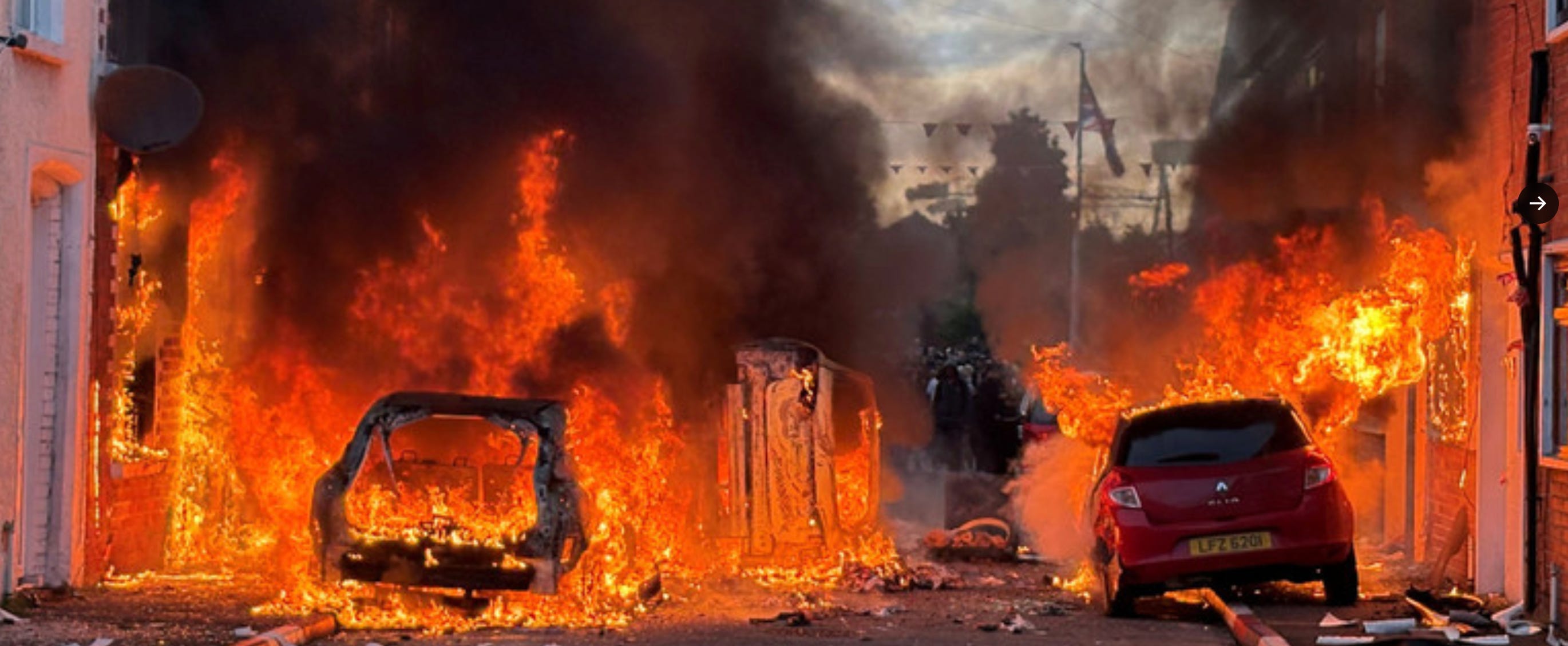
In the damp, twitching guts of Belfast, where Irish history festers like an unhealed wound on this Island, the masks came out again on Tuesday evening. Not the jolly linen sort for parades or commemorations, but the balaclava kind, the kind that turns men into punctuation marks in someone else’s nightmare. They burned a bus, they burned cars, they set fire to bins and houses as though the city itself were a 12th of July effigy waiting for ignition. The night before, a man had taken a knife to another man’s head and neck in the kind of casual savagery that now travels the internet at the speed of outrage. A Sudanese man in his thirties has been charged with the attempted murder of Stephen Ogilvie, possession of a knife, and of “making threats to kill and a National Health Service worker.”
Belfast was once the kind of place where threats to kill were not rhetoric but as reliable as the local weather reports. You said the words, and the sky immediately began to turn black. By nightfall, the pavements would be wearing someone else’s blood like an old coat. A man might mutter words in a bar, over a cold Guinness and even colder eyes, and the sentence would already be halfway to its location in the back of one of Belfast’s famous black taxis or the entryway of a target’s semi-detached house. No gap, no polite having to think about it. The threat was rarely a warning but more like a future booking of some sort. The murder had the discourteous inevitability of Irish rain. That was the old grammar of Belfast City: subject, verb, object, corpse. You might even get a few of the wee pretend soldiers in balaclavas fire some shots over yer coffin. It was such a regular thing in Belfast, you could set your watch by it. There’d be something incomplete if some atrocity were absent from the daly news bulletins. Now the same murderous intent out of a Sudanese man and the whole apparatus of modern astonishment whirrs into life, headlines, hashtags, flaming buses, as if the city had forgotten its once native tongue and was scandalised to hear it spoken again by a stranger.
The video, of course, was everywhere: grainy, intimate, shocking in its brutality, the blade rising and falling like a question that never quite receives an answer. Why? Within hours, the social media accounts, those tireless merchants of recycled terror and monetised panic, had summoned their digital levée en masse. Come out, they said. Defend yourselves. As if Belfast had ever needed encouragement to tear itself apart. And so the process of The Troubles repeats: a single act of horror is alchemised into collective permission to revert to form the addlepated international media. One foreign blade becomes proof of an invading horde; one night of flaming bins becomes proof of righteous native fury. The city, already exhausted by its own past, finds itself performing the future that was promised to it by every algorithm and every demagogue with a social media account. Masked men torching public transport in the name of civilisation. This is not politics, not really. It is closer to a weather event: low-pressure systems of resentment, drifting in from the X, META, Telegram, colliding with the local atmosphere thick with old and unresolved grievances, and producing the same predictable sectarian storm. A man tries to behead another. The footage circulates like a virus. The streets answer in fire and hatred. Tomorrow, there will be condemnations, inquiries, and solemn editorials about “community tensions.” It’s Belfast, we’ve been here before.
Hundreds of masked men moved from street to street in North Belfast like a single black centipede of destruction, bottles and bricks clutched in one hand, mobile phone in the other, the way other people might carry the shopping. “Foreigners out,” they chanted and other racial slurs. I had a sense of Deja Vu watching it, glued to the voyeurism on social media and Sky News with the rest of the world. Mobs moved door-to-door like the census-takers from hell, knocking, kicking, peering through letterboxes for the wrong religion, the wrong ethnicity, the wrong accent, anything that didn’t fit the narrow, furious grammar of North Belfast belonging. A syllable out of place, and the petrol bomb was already in flight; a name that tasted foreign, and the petrol was already dreaming of flame. They were not rioting so much as performing a grotesque audit of the street, ticking boxes in blood and broken glass. We’ve seen this before in the mid-90’s.
They kicked over bins and set them dancing with flame, hammered on more doors and put their boots through windows with the brisk efficiency of men who had done this before, or at least had taken instruction from social media. Numerous cars went up. Petrol or lighter or pure communal will had already begun its work when a woman burst from her front door and announced, with the weary authority of someone stating a known fact, that the vehicle belonged to a local, not a foreigner. The mob paused, the flames thought twice, and the car was spared. In that small, pathetic moment, the entire farce revealed itself: the rioters were not burning the abstract idea of the outsider attempting murder, so much as performing a grim, meticulous audit of belonging. Wrong postcode, wrong accent, wrong skin. correct car. Proceed to the next target.
Our screens were filled with it, as they always do these days, shaky clips of people spilling out of their houses into the Belfast night, coats thrown over pyjamas, children clutched like precious brown parcels, while the flames behind them licked higher and turned the ordinary windows into a screaming béal na péiste. Northern Ireland Fire and Rescue, the mental health nurse to Northern Ireland’s schizophrenia, logged sixty-two separate incidents, sixty-two little infernos blooming across the map like measles on a child’s skin. Light the match, film the flight, upload the panic. Sixty-two times over, the old Belfast streets rehearsed their latest shame: ordinary doors opening not into safety but onto the ancient, patient hunger that is probably your neighbour. We’ve seen this before. Other families in other countries, Bosnia, Rwanda and other dark places that have slipped from the conscience. Even if the Belfast violence is diminished compared to the horrors of the past, it’s still the same playbook.
In 1994, over eight hundred thousand Tutsis and moderate Hutus were hacked, shot, burned, and clubbed to death in the space of three months. Among the architects of this abattoir was a Georges Ruggiu, the only foreigner ever hauled before the UN court for his part in the genocidal Rwandan hate. He sat behind a microphone at what the world soon learned to call “hate radio,” a cacodemonic little radio station that spent its days spraying incitement like cheap pesticide: names, addresses, instructions, the daily worship of extermination. While the machetes rose and fell outside, he spoke in calm, professional tones, as if reading the weather or the football scores. Kill them. Kill them all. They are cockroaches. They are snakes.
The accents are different, of course, the medium is much faster, but the rhetoric is the same. Over the past few days, foreign voices, accents from London, from America, from Russia, from the glowing bowels of social media channels and livestreams, have poured the same thin, venomous syrup into Belfast’s ears in recent days. They do not need radio instructions; they have algorithms. They do not broadcast from Belfast but from bedrooms and studios thousands of miles away, yet the message arrives crisp and urgent on your devices: here are the addresses, here are the targets, here is the enemy. Foreigners out. Burn it. Defend yourselves. They speak with the same professional calm Ruggiu once used, the detached reasonableness of men who will not have to smell the smoke or step over the broken glass. Streets trend, clips loop, outrage is farmed, harvested and recycled before the first bin is even lit. A single attempted murder becomes epidemiological proof. A neighbourhood becomes an occupied zone. The foreigners in Belfast are not merely present; they are, according to these distant inciters, an existential pestilence requiring the remedy of past centuries. The radios have shrunk to pocket size, and the hate has gone digital. We’ve been here before, it is identical: an outsider telling the locals who deserves to live on their street, who deserves the flame, who is a cockroach and who is not. Only the accents change. The pogrom is more real now, more photogenic, better documented. And somewhere in the background, the knife will still be falling, endlessly, in loops, feeding the next cycle before this one has even cooled. Belfast keeps burning the same bus, over and over again. Only the passengers change.
You Can't Eat A Flag

Journalist - “Your father once said to you, You can’t eat a flag, what did he mean by that?”
Musk and Tommy Robinson would like everywhere to be like Northern Ireland. Decent people must stand together. No one should be made feel unsafe in their home. No one.
Your commentary makes me sad for the repetitive hate-filled actions accruing in Belfast and across the US. Good and moral individuals must unite to fight the injustice and violence against those whose origins are elsewhere. Otherwise what kind of world exists for our children?