
Irish Nationalism Won’t Look Beyond the Six Counties
An Irish solution to an Irish problem.

The famous Haughey quote, “An Irish solution to an Irish problem,” is 47 years old today, but it is still relevant. It’s that peculiar Irish machination, the political class mutters about when it wants a crisis to go away without actually being sullied by touching it, a political phrase that means: we will build a flimsy papier-mâché contraption out of fudge and obfuscation, wheel it in front of a nervous public, and call it a resolution. Begotten with Ireland's original prince of darkness, Charlie Haughey, mumbling about contraception in 1979, it has come to describe the great national art of never confronting anything that might be perilous to one’s political career. Instead, skirting around the issue with clever procedural footwork and ill-thought-out half-measures, while insisting with a straight face that this evasive little shuffle is, in its own way, a uniquely Irish form of facing the challenge, not by dealing with, but by whistling past the graveyard.
Irish nationalism has always been fond of maps. Our island, the line, the six counties, the twenty-six counties, like a missing tooth in the smile of our nation, this is the cartography of our emotions. We ache for a 32-county republic complete, a green blot with no British fingerprints smudged on the corner. We sing about the soil and weep over vainglorious loss and border posts and forgoteen heros, as if modern power still lives in the shape and blood of our fields. Meanwhile, the actual frontier of the Irish state, our skies, our seas, the seabed bristling with cables that carry the world’s nervous system—lies mostly undefended, patrolled by other nations’ aircraft and other nations’ ships, for other people’s reasons.
We are, in our own estimation, a proud and sovereign folk, so long as the sky stays empty and the sea keeps quiet. The moment something flickers above us or stirs beyond the coast, the mask slips; the sovereign independent grandeur dissolves into outsourced anxieties, and a bureaucratic embarrassment that always follows a crisis we’re not equipped to name, let alone deal with.
The national story goes like this: a small nation, fiercely fought an independence struggle from an empire, a stubborn nation, neutral and independent, standing aloof from imperial entanglements, too morally refined to get its hands dirty with the vulgarities of realpolitik and geopolitical realities. But neutrality is not a philosophy here; it’s a brand strategy, a folksy Irish dancing costume for a country that quietly subcontracted the normally boring, expensive parts of sovereignty to its neighbours. We howl about British soldiers in Northern Ireland, while politely depending on British pilots to chase away anything suspicious that wanders into “our” airspace. We grip the rosary beads of independence with one hand while the other hands the sovereign keys of independence to London and Paris and asks them to watch the house while we’re at the pub discussing how Russian fascism has no interest in Ireland, sure, we’re harmless.
This is not some noble refusal of militarism. It’s a kind of spiritual freeloading.
The Irish state and elements of our political class have discovered a remarkable geopolitical innovation: the concept of “sovereignty, terms and conditions apply.” On paper, the airspace is ours. In practice, if a rogue aircraft or drones appear heading toward Dublin, or down the west coast of Ireland, it will most likely be a British jet that screams up to meet it, its pilot politely pretending this is all a normal extension of neighbourly goodwill and not the quiet admission that our much-vaunted republic can’t, in a tight spot, have the ability to get off the ground. This proud, historic nation, cradle of saints and scholars, is basically a Ryanair departures board with delusions of grandeur.
Look at the numbers, if you can bear the boredom. A defence budget that could barely keep a medium-sized American suburb in fireworks. A navy that would struggle to escort a cruise ship, let alone protect an oceanic frontier. A chronic inability to monitor, never mind defend, the strands of glass and data that run along our seabed and keep most of the world talking to itself. We sit on a tangle of undersea cables that connect North America to Europe, a nervous knot in the global system of communications, and our attitude to this is essentially: sure, the Brits will keep an eyeout for us, won’t they? Maybe the French, if they’re not too busy having a navy. In recent days, even the Germans have been patrolling our waters. The last time the Kriegsmarine, as they were known then, got this close to Dublin, they were looking to sink some British ships. Now they have a more noble task, defending a country that can’t defend itself.
For a movement so obsessed with the betrayal of 1916, Irish nationalism has developed a strange tolerance for the ongoing betrayal of reality.
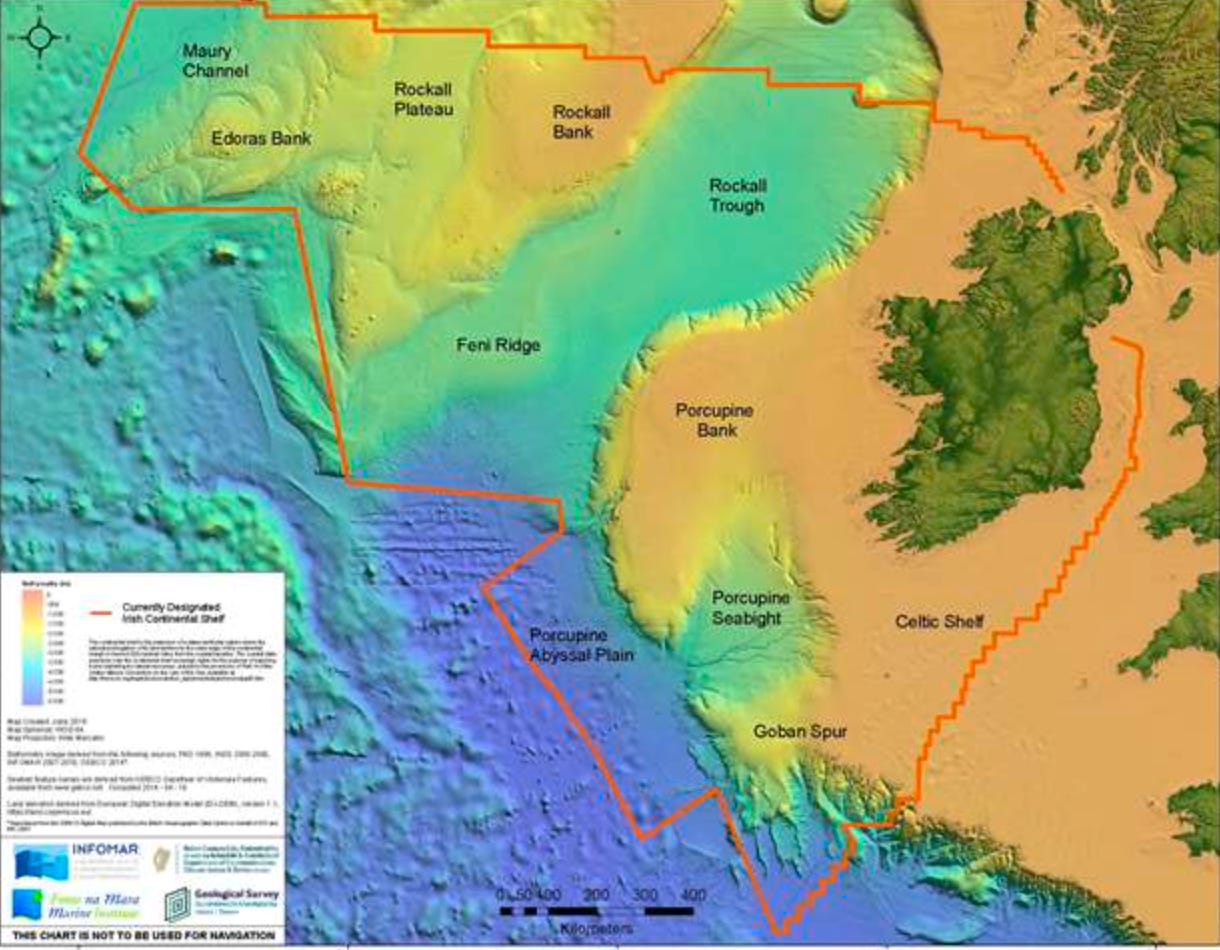
Because reality is this: in the twenty-first century, the real partition isn’t on land. It’s between what we pretend to own and what we can actually protect. We claim a vast exclusive economic zone, but the words “exclusive” and “zone” here have the forced confidence of a lad insisting the bouncer definitely knows him. The cables, the energy interconnectors, the ports, the shipping lanes - these are the beating apparatus of state that keep the country’s economy alive, and they are kept safe and patrolled by powers we like to define ourselves against in song.
They patrol our air and seas for their benefit, also, not just out of kindness. When the Royal Navy pokes around our waters, when NATO-types swivel their binoculars across our horizon, they do not do it out of tender regard for the harp and the shamrock and take pity on us. They do it because what lies off our coast matters to them: their data, their trade, their strategic depth, our strategic weakness. If it aligns with our interests, that’s a happy coincidence. We’ve mistaken the overlap of interests for a guarantee. We’ve confused “they don’t want this blown up either” with “they’ll always save us because we’re neutral.”
Elements of our political class, particularly the uber-nationalists, sell this dependence as moral refinement. We don’t have jets, you see, because we’re peaceful. We don’t have a serious naval capacity because we are not like those vulgar, bellicose countries that think in terms of realpolitik. We spend pennies on defence and call it a principled repudiation of militarism, like a man refusing to pay his restaurant bill because he’s opposed to capitalism. The actual principle is simple: Let someone else pay for our security.
Meanwhile, the nationalist imagination continues to stay landlocked. It is still 1972 in some politicians’ heads: soldiers, street barricades, flags over council buildings, arguments about lines on atlas maps or so-called peace walls. But the world is no longer arranged around infantry and checkpoints. Coercion now travels along cables, through ports, via disrupted satellites and severed infrastructure. You can cripple a state without ever sending a single soldier across a line. You just cut its nervous system a few kilometres offshore, in that blank blue bit of the map that so-called Irish Nationalism has never bothered to read about or appreciate.
And that’s where the hypocrisy sharpens into something uglier. If nationalism is the claim that a people should rule itself, then modern Irish nationalism has chosen a highly selective definition of “self” and a very relaxed definition of “rule.” We insist on the right to control territory we do not control, while showing no real interest in controlling the domains we already have. We rage at the idea of British authority in Belfast but shrug at British authority at 30,000 feet above County Laois or a British warship chasing Russian submarines away from Cork harbour. We romanticise Wolfe Tone and denounce Castle rule, and then outsource the last-resort monopoly of force over our own skies to the heirs of the Castle because radar is expensive and fighter jets are vulgar.
This is not anti-imperialism. It’s an aesthetic preference. All sound, noise and bombast, no substance.
We congratulate ourselves for not joining military alliances while quietly nesting inside the security envelope created by those alliances. We bask in the warm moral glow of neutrality while acting, in practice, like a tax exile from the responsibilities of sovereignty. The line is always the same: “Why would anyone attack us?” As if being useful to bigger powers - by geography, by infrastructure, by economic function - has never historically drawn trouble. As our island’s value, as a corridor and a critical node, does not increase precisely as we host more cables, more data centres, and more connections. As if the Russian submarine, snuffling along our seabeds like some blind, steel animal, will gently unclamp its jaws from the cable, flick on the cabin light, and consult Ireland’s Wikipedia page - and say it seems these nodes of global capital and data are draped in the soft vestments of neutrality, best leave them untouched.
The maddeningly saturnine thing is that the solution is not even particularly radical. Nobody is asking for an Irish aircraft carrier battle group to steam heroically through the North Atlantic. An honest, adult nationalism would start with something much more competently boring: a serious radar picture, a small but credible air component, an overworked and underappreciated navy that can function properly, a legal and institutional framework that treats seabed cables and maritime infrastructure as vital national instruments of state, not background scenery. It would mean accepting that if you want sovereignty, you have to pay for the hardware that makes sovereignty more than a wink or a nod or some rhetorical flourish.
But that requires giving up the narcotic comfort of the current story. Because once you admit that the republic relies on the UK and France and a general European security consensus to keep its arteries intact, you have to stop talking like a heroic little island standing alone in a cruel world. You have to admit that our posture is just speaking out of both sides of our mouth. You have to replace the romance of being permanently put-upon with the tenebrous responsibility of self-defence.
And that, fundamentally, is why the hypocrisy persists. It lets everyone have what they want. The so-called self-proclaimed nationalists get their rhetoric, their songs, and their refusal to grow up. The state gets its budget savings. The neighbours get their strategic interests taken care of, but with impudent Irish moral smugness. It’s an Irish solution to an Irish problem: everyone pretends, and nobody says the quiet part out loud, that our republic is not defended by the republic, but by other people who are happy for us to be a republic.
If you stood on the Cliffs of Moher and looked out over the Atlantic, and if you could see power the way you see weather, you’d see it: planes that aren’t ours, ships that aren’t ours, guarding infrastructure that supposedly is. An invisible architecture of other people’s guarantees, arching over a country that insists it is nobody’s client. Irish nationalism, for all its baroque thunder and self-mythologising, has engineered a peculiar monstrosity: a supposedly independent state that behaves like a sulky adolescent, slamming the bedroom door and howling “you’re not the boss of me” from a mortgage it never pays, in a house quietly underwritten by other people’s power.
It is possible to be more than one thing at once. I can be an Irish nationalist in favour of a strong military and also be in favour of joining some kind of alliance.
On the military, it is frustrating to see military capabilities and neutrality conflated. They are separate issues and should be treated as such.
The Republic should build up its army, navy and air "corps." It needs radars, jets, drones, anti-drone defences, missiles and so on. Think Taiwan.
It needs to pay more to soldiers and sailors, and to make the military an attractive career option. Either that, or introduce some kind of compulsory service.
The military alliance is trickier. Do you want to join NATO when the president of the largest power (by far) is a Russian agent? And when the head of NATO is some deluded Dutch eejit with "daddy" issues?
Then there is the question of what our current "neutrality" looks like. Has it ever been defined by anyone? Aren't we in some Nordic battle groups already? And NATO's so-called Partnership for Peace? So yes, a little honesty would go a long way.
Finally, your jibes. I am sure jeering at nationalists is fun — and beside the point. Nevertheless, your sneering might get you a column in the Irish Times some day. God knows, south Dublin needs more sneerers.
Well written and carefully argued. If only such logical clarity of thought was more common in the political sphere.