

The Murder of Eamon Ryan
Sinn Féin/IRA would like you to forget about it.

Eamonn Nolan, who was guilty of murdering a civil servant in front of the man’s three-year-old son, has resurfaced—not in a prison visiting room, but on the campaign trail. It’s 1979, or rather, it’s now: Nolan, a senior Sinn Féin official, did 14 years for his part in the callous murder of Eamon Ryan during a bank job in Co. Waterford. He got a life sentence. He served some. And now? Now he’s smiling and holding leaflets for Janice Boylan, Sinn Féins by-election candidate in Dublin Central.
There is a particular kind of insult reserved for the victims of I.R.A history: not the violence itself, but the rewriting that follows. The careful sanding down of brutality into something more palatable. The transformation of gunmen into “statesmen,” of wanton murderers into “peacemakers,” of the indefensible into something to be quietly understood, and then forgotten.
Eamon Ryan cannot be forgotten. And that is precisely the problem for Sinn Féin.
On an August day in 1979, in a small AIB bank in Tramore, a young civil servant lay face down on the floor. He was unarmed. He was no threat. He was not part of any “struggle.” He was there with his three-year-old son. He was shot at point-blank range anyway. Let’s be clear about what that was. Not collateral damage. Not a tragic misfortune. Not the blurred edge of conflict where responsibility becomes murky. A vicious, unwarranted murder.
Eamon Ryan was 32, not old, not really. Barely old enough to have assembled a proper past, let alone the future that was so casually cancelled on a grey morning in Tramore. Thirty-two: the age at which a man is still young enough to believe the world might yet be gentle, yet old enough to understand that gentleness is a privilege rarely extended to civil servants who happen to be in the wrong bank at the wrong time. He was shot dead by members of the Sinn Féin/IRA during a bank robbery in Co. Waterford. A civil servant, which is to say he might have spent his days pushing paper across desks in exchange for the modest, unheroic dignity of an ordinary life. No flags, no anthems, no grand revolutionary destiny, just the small mercies of routine, a wage packet, a wife waiting at home. That life ended with the usual IRA brutality: sudden, loud, and final. A bullet balancing the accounts of someone else’s glorious struggle. He left behind Bernadette, his wife, and two children, Peter and Dorothy. Names that now carry the weight of a permanent subtraction. Two small people handed a sentence far crueller than any handed down by the courts: they would grow up circling the hole where their father should have been, learning early that the world is capable of tearing a man out of existence in front of you and then expecting you to carry on as though the shape of him hadn’t been violently excised from the family forever. Eamon Ryan was an innocent man executed for being in the wrong place at the wrong time.
This is the part that resists sanitisation. The part that cannot be folded neatly into the language of “struggle” or “cause.” Because whatever else was happening in Ireland at the time, whatever political narratives were constructed before or after, this was something brutally simple: an unarmed man, executed on the floor of a bank, in front of his son.
After the shot was fired, he was kicked as he lay dying. His three-year-old child beside him.
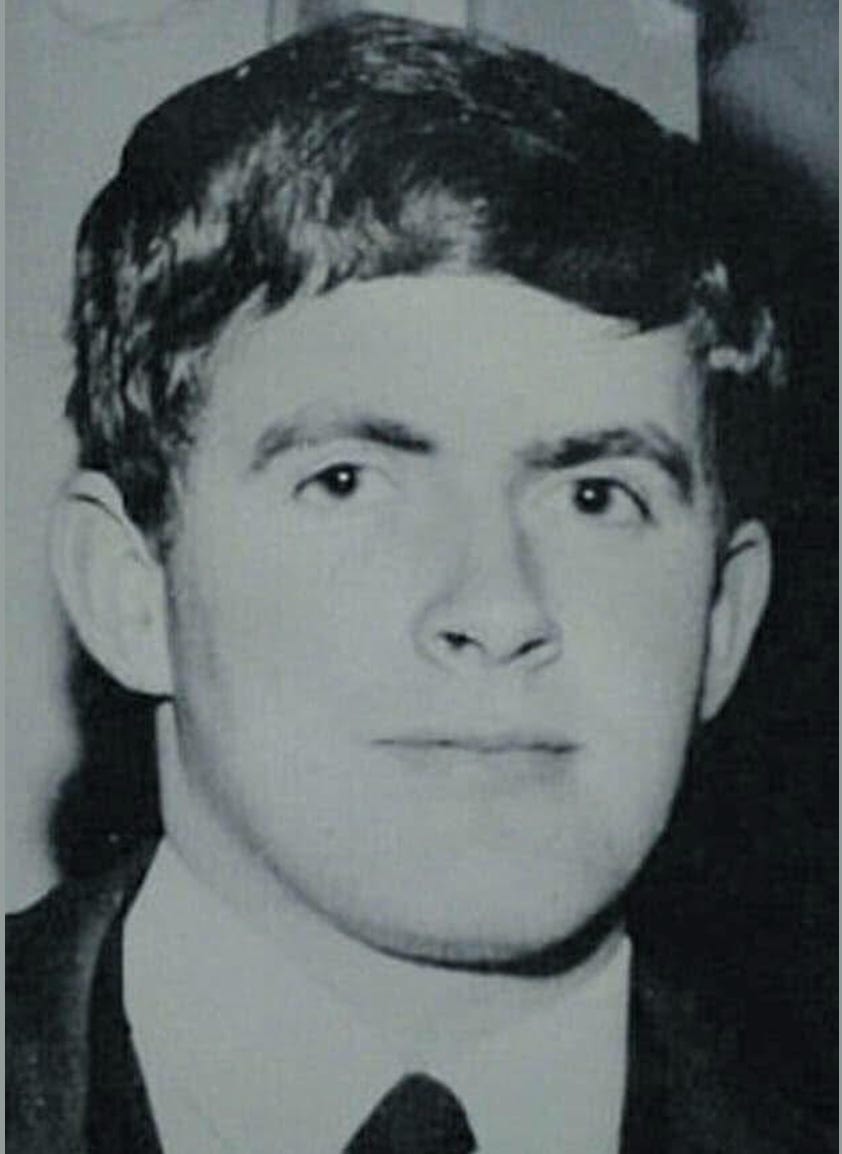
This is the reality that sits behind the language, the euphemisms, the speeches, the carefully stage-managed public memory. Because while some now speak in the tones of reconciliation and statesmanship, and sure isn’t he a grand lad that he swapped the bullets for the ballot. The facts remain stubbornly unpolished. The Sinn Féin/IRA organisation carried out acts like this. Not rarely. Not accidentally. But as part of a campaign in which civilians were expendable.
And yet, decades later, those involved in the murder are honoured. Celebrated. Applauded for their “service.” Their pasts softened into phrases like “service” and “commitment,” their roles reframed within a broader story that they demand you must understand and venerate said “service”
Service to what, exactly?
A chair unfilled. A life interrupted. Children raised with stories instead of a father. A wife who accepted a university degree on behalf of a man who would never receive it himself. A sister who cannot, and will not, “get over it,” because grief does not obey political timetables. No service to his widow, who buried her husband and raised their children alone. Not to the three-year-old boy who stood close enough to witness his brutal murder. Not to a family that has waited, year after year, not for vengeance, but for something far more basic: acknowledgement, explanation, anything at all, that never quite comes.
Instead, they are told to move on. “The struggle”, “the cause”, or other bullshit euphemisms are used to justify what was, in some cases, like this, a gratuitous murder. Move on, from what? From the image of a man shot on the ground? From a childhood defined by absence? From a life cut short in the most deliberate way imaginable? One feels a certain vertiginous disgust at the smoothness of the transition from murderer to “community activist”. Sinn Féin has a lot of them.
To add insult to injury: there’s the expectation that grief should have an expiry date, that memory should yield to political convenience. That the victims of violence should quietly step aside while those connected to it are recast as architects of peace, their pasts selectively edited to suit the present. From the image of a man shot on the ground? Not because it is merely inconvenient, after all, inconvenience is a small thing, the sort of petty embarrassment that can be waved away with a press release and another slogan. No. They want it to vanish because the public still sees the monsters moving among them, smiling for the cameras, holding leaflets, shaking hands in Dublin doorways. The past is not just some dusty archive; it is a man, bleeding out while his three-year-old son watches. It is Eamonn Nolan, trigger finger now politely folded around a canvassing clipboard, the same man who once taught a child the final lesson in revolutionary pedagogy. The laundering of blood into ballot papers.
Because the truth is this: you cannot build a credible narrative of peace on a foundation of evasion. You cannot ask an island to forget while refusing to fully reckon with its past. And you cannot claim the authority of a peacemaker while sidestepping the moral weight of what was done in the name of “the cause”
Eamon Ryan’s story deserves to be told precisely because it resists being absorbed into another Sinn Féin/IRA myth. It is too stark. Too human. Too unforgiving of spin. The Troubles did not end; they simply learned to speak in focus-grouped soundbites and pose for photographs beside Sinn Féin election candidates. The child who watched his father die is still out there somewhere, carrying a memory that no by-election flyer can erase. Meanwhile, Eamonn Nolan smiles for the camera, doing his bit for the movement. Progress, they call it.
Audrey Magee includes this atrocity in her wonderful novel The Colony. It’s good that you have called this out now - the getaway driver was an SF candidate later in local elections in Waterford. No shame.
Thank you for ensuring Eamon Ryan’s murder is not forgotten.
A very emotive piece - especially that bit about how he kicked the dying man, and the fact that his 3 year old son witnessed this barbaric and unnecessary act.
Sinn Fein keep on elevating their past terrorist and murderers to positions of party influence.
They are not the political-only party they pretend to be.