
Tax-Free Human Rights
The Influencer Mirage of Freedom and Safety in the UAE

Human rights in the United Arab Emirates are not rights in any meaningful sense; they are a façade. They exist the way an infinity pool exists, reflecting the sky for a moment before spilling into nothing. You are not supposed to test their depth. You are supposed to take a photo, tag the location, post to insta and move on.
Dubai sells itself as a kind of end‑of‑history resort. It’s less a city than a subscription service for reality, premium tier: everything refrigerated, polished and delivered to your door in under fifteen minutes by slaves. The influencer lifestyle is full of looping content in which beautiful people with strange smiles, large lips, and soulless miens disseminate official government instructions on how to exist there. Of course, you will not be told that some of them are being paid for their propaganda or are secretly living in fear of saying the wrong thing. Getting arrested, having fingernails pulled out and being deported. That kinda trivial thing.
The Dubai influencer isn’t just selling you a lifestyle; they’ve signed a digital non‑disclosure agreement with a totalitarian regime. Their job is to point the camera everywhere except at reality. The deal is simple: you can pan lovingly over towers, sea front brunches and Lamborghinis with gauche enthusiasm as long as you never so much as tilt the lens toward where the slave workers exist, who built the skyline, trafficked women who serve the nation’s religious and political hypocrites. Whatever you don’t highlight authoritarian legislation; that quietly keeps everyone posting the same unexceptional content.
These influencer parasites like to talk about “authenticity,” and then dutifully hand in their critical faculties at passport control. They pose in front of a carefully curated absence: no prisons, no deportations, no crushed unions or criminalised dissent, just one long, looping advert for a country that only exists for their content. What you’re seeing isn’t Dubai; it’s the regime’s front‑facing camera, filtered, softened, and posted with a tacit implication.
UAE Politics has been resolved into a series of brand partnerships. There is stability, there is safety, and there is financial growth. If you find yourself wondering, “at what cost?” that is a personal failing, a mindset problem, something you should work through with a life coach in a coworking space overlooking the marina. The entire country is curated to stop you from asking that question. People talk about “the social contract,” but this is something stranger, a social NDA. The state will give you everything you thought you wanted: tax‑free income, air‑conditioned ambition, brunch presented like ritual sacrifice to the gods of content. In return, you agree not to notice that you are living inside a mirage. You may speak freely about anything, as long as the regime approves.
Because there is a whole parallel reality here that must never quite come into focus. A place where criticism is not answered but quietly suppressed. Where politics is not contested but preemptively strangled with kid gloves, probably made by kids. Where the line between “crime” and “embarrassment to the authorities” is so thin it may as well be a hairline crack in your phone screen. If you insist too loudly that you have rights, rights as in claims enforceable against power, not as in “the right to network on LinkedIn, you will discover that what you actually have is a residency visa and a problem.
The system is clever. It does not need to constantly crack down, because it has turned everyone into their own censor. Laws against “offending the state,” “harming its reputation,” “spreading rumours” hang over public life like unspoken etiquette. You don’t know exactly where the boundary lies, only that it exists. So you learn to talk around things. You develop a kind of conversational feng shui, arranging your sentences so that no sharp corner points directly at power. You can complain about the heat, the traffic, your workload, and your carefully curated existence, never about the fact that in a country where slavery still exists and has surgically removed human rights from public life and replaced them with “vision documents.”
Into this void steps the influencer, the regime’s favourite citizen. They are not just paid propagandists; they are something more useful, a self‑sustaining hallucination. Their job is to prove, simply by existing, that none of this matters. Watch them glide past towers that look like USB sticks stabbed into the desert. Watch them lean over a balcony and tell you that you, too, could escape “the negativity” back home, by which they mean functioning trade unions and the ability to call your prime minister an imbecile without worrying about getting tortured.
These people talk about “freedom” in a place where freedom has been boiled down to dietary choices and passport stamps. They have never voted here, and never will. They will never join a demonstration, because demonstrations do not happen. They do not belong to trade unions; they belong to content houses. Their sense of liberty is purely gravitational: the dizziness of not paying tax, the weightlessness of leaving behind a social order in which ordinary people sometimes, annoyingly, interfere with the plans of the rich and useless.
The real trick is how easily this feels like an upgrade. Democracy is messy, slow, and frequently stupid. Courts are fallible. Journalists are irritating. Protesters block the road when you’re late. In the UAE, none of that obstructive citizenry exists. Nothing gets in the way of “vision” and “progress”, and “content, endless streams of the same bland, botoxed insignificance. The trains, if there were any, would run on time. You no longer have to tolerate the embarrassing spectacle of fellow humans trying to decide how they are governed. Someone has done that for you, permanently, and given you a balcony in compensation.
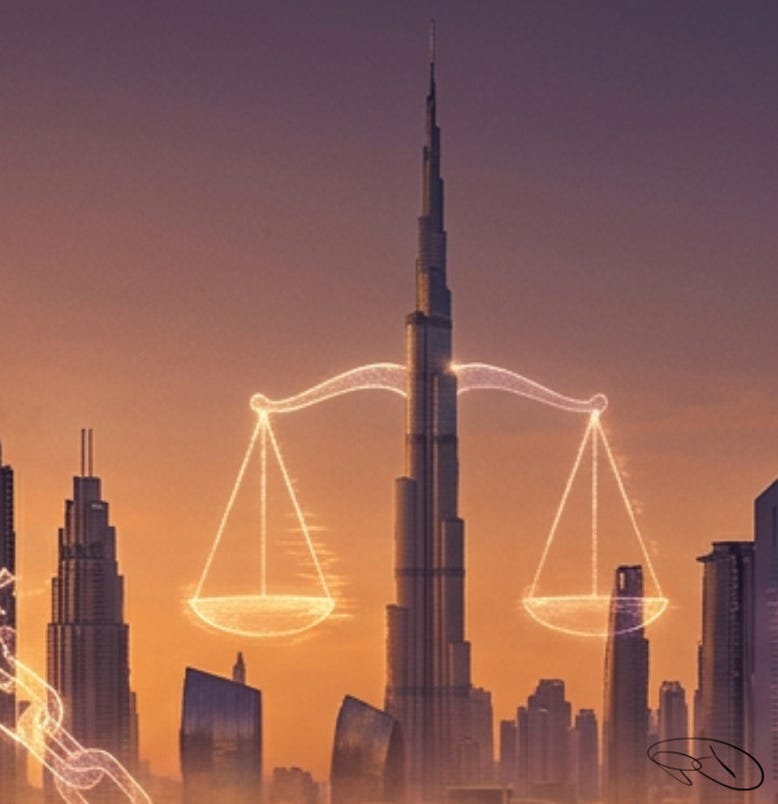
The absence of income tax is sold as a kind of emancipation. No more state with its hand in your pocket. But in the liberal democracies these people flee, tax is the grubby mechanism by which courts, teachers, doctors and ombudsmen are funded, imperfect tools that occasionally force the state to obey its own rules. What you are really trading is boring, procedural protections for the right to keep every cent of your earnings until the moment the system decides it doesn’t like you. In that moment, you will find that the government you never paid for owes you nothing.
Meanwhile, the entire arrangement sits on a foundation that must not be spoken about in polite, brunch‑adjacent company: the vast underclass of migrant workers who built the towers, clean the lurid shops and live in conditions carefully quarantined away from the influencer’s field of view. The miracle of the desert city is powered by people who are not invited to share in the mirage of rights at all. Their existence contradicts the fiction that this is a meritocratic playground for the global content zombie class, so they are edited out, cropped at the ankle, blurred into the background, rendered as “service staff” if they are acknowledged at all.
This is what passes for human rights in the UAE and most countries in the Middle East: the right to turn your head away. The right to live in a perpetual panoramic shot, all skyline and no street. Rights have become a matter of optics; if the surface looks smooth enough, we are invited to conclude that justice must be happening somewhere in the foundations. There are, of course, formal guarantees and official statements and English‑language reports about “commitment” and “reform.” These are not there for you to rely on; they are there for you to quote back at yourself when you start to get nervous because you said the wrong thing in public.
Human rights in the United Arab Emirates are not violated by accident; they are structured out of the system on purpose. The country’s legal architecture is designed less like a set of rules for citizens and more like a user manual for a very sensitive machine: do not touch, do not question, do not open the casing. If you want to understand the UAE, don’t start with the skyline; start with the laws that tell you how small you’re supposed to feel beneath it.
At the core of this order sits the cybercrime and “rumours” framework, a law written in the nervous, paranoid prose of a state that never wants to be publicly embarrassed again. Here, you do not simply get punished for inciting violence or doxxing your neighbour; you can be prosecuted for “harming the reputation” or “prestige” of the state, for spreading “false news,” for sharing documents that might “damage public confidence.” These are not legal categories so much as vibes, and that is exactly the point. In a liberal democracy, law tells you what you cannot do; in the UAE, it tells you that anything which makes the authorities uncomfortable can be retroactively defined as a crime.
Layered on top of this is an expansive system of counterterrorism and extremism statutes that treat dissent as a branch of national security. Terrorism, in this vocabulary, is not just bombings or kidnappings; it can mean “antagonising the state,” “stirring panic,” or joining an organisation that exists mainly on paper and in the heads of worried bureaucrats. Activists, human‑rights defenders, and political reformists find themselves accused of terrorism not because they planted bombs, but because they planted ideas. Once you are in that category, the penalties, extreme sentences, indefinite detention, and even the death penalty, stop being theoretical and start being a tool of domestic discipline.
The result is a kind of legal panopticon. Political parties, as you’d recognise them in Europe or North America, do not exist. Human rights are squeezed out of reality. Civil society organisations that try to function independently of the state are either strangled at birth or wrapped in regulatory red tape until they suffocate. Freedom of association becomes a permission rather than a right: you may gather to praise, to network, to do business, but not to challenge. The courtroom, instead of being a place where individuals and the state meet on nominally equal footing, becomes an extension of executive power, cloaking decisions taken elsewhere in the language of “security” and “stability.”
Recent media regulations complete the loop. Traditional press, online outlets, and even influencers are funnelled into a regime of licensing, content rules and back‑end pressure that makes it dangerous to publish anything that reads like real journalism. “Fake news,” “sectarianism,” “harmful content” – these words are not carefully defined because their power lies in being elastic. A government genuinely interested in free expression defines its restrictions tightly; a government interested in control defines them so broadly that any unwelcome fact can be made to fit.
Most chilling of all is how far the state’s reach extends beyond individual dissidents. If you speak up, it is not only you who may face arrest, trial on sweeping charges, and long‑term imprisonment; your relatives, business partners and even companies abroad can be tarred with the same “terrorist” brush. Travel bans, asset freezes, reputational smears – collective punishment by legal designation. It is a message written in the lives of other people: your politics are no longer yours alone; they are a liability for everyone who knows you.
What emerges from all this is not simply a place with “tough laws” or “strict standards.” It is a system in which the idea of enforceable rights, claims you can make against power, backed by independent institutions, is replaced by a structure of conditional privileges. You may speak until the state decides you have said the wrong thing. You may organise, until the state decides your organisation looks a bit too much like politics. You may stay, prosper, build a life, until you collide with interests that matter more than your existence or if you happen to be gay, which carries a prison sentence of up to 10 years. It’s nice and safe so long as you’re heterosexual.
This is why talk of “freedom” in the UAE, especially from the mealy mouths of wealthy expats and influencers, feels so weightless. Freedom, as they use the word, means not paying income tax, not dealing with striking workers, not having to think about elections or protests or awkward newspaper headlines. It means the ease of a world where politics has been tidied away by someone else. The legal reality beneath that ease is very different. It is a dense, deliberate web of provisions that keeps power concentrated where it has always been, and ensures that anyone who tries to pull at the threads discovers how little they were ever allowed to touch.
The strangest thing is how many people, fully aware of all this, still move there and call it safety and freedom. They have confused the absence of obligations with the presence of rights. They boast about being “sovereign individuals” while living in a place where sovereignty is precisely the one thing they do not possess. They insist they have “never felt safer,” as missiles rain down, which is true in the way a well‑behaved child in a very strict household feels safe: nothing bad will happen to you as long as it doesn’t occur to you to want anything you aren’t meant to have.
The desert is honest. It tells you what it is: a vast, indifferent expanse in which you are small and fragile and temporary. The city built on top of it is less truthful. It promises that you can step outside politics, outside history, outside the tedious business of being a citizen, and live instead as a frictionless consumer in a climate‑controlled now. It is a beautiful lie, and the price of believing it is simple. You give up the dull, annoying, argumentative freedoms that make you a political subject with human rights, and in exchange, you become the content you post.
Very eloquent destruction of the "I feel safer in Dubai than on the streets of London" (substitute any city of your choice) missives filling the world of Social media and dodgy right wing politics. However you forgot to mention that it is a soulless, cultureless piece of classless architecture stuck in an oven.
How are these people not bored out of their minds? It is no wonder that the ultra rich become deviant and dangerous. For all of their brilliance and innovation humans can’t escape the trait for self destruction. If nature can’t cull the human herd with disease and disaster it will use hubris and ignorance. None of us get out of here alive.