
The Killing Fields of Aughinish
Ireland enabling Russia's Barbarity

On 24 March, a consortium of European investigative media outlets, those tireless bloodhounds of the liberal conscience, forever sniffing out the precise coordinates of Governmental sins, reported that the Russian-owned Aughinish Alumina was shipping the lion’s share of its alumina exports straight to Russia. The supply chain has been traced with grim, meticulous precision by The Irish Times in collaboration with the OCCRP, and the kind of people who still believe journalism is a vocation rather than a content farm. And that this innocuous appearing white powder, this refined essence of bauxite, was finding its way, with all the inexorable logic of capitalism, into the aluminium exoskeletons of ballistic missiles and drones. Missiles and drones that have since rained their particular brand of Russian state-sponsored barbarity down on civilian targets in Ukraine: schools, hospitals, apartment blocks, the usual inventory of Russia's recent war crimes in Ukraine, but also the Sahel in Africa and chemical weapons in Syria.
In Aughinish, they take the good earth of Limerick, mix it and subject it to a kind of violence: heat, chemistry, vast clanking machinery, the whole groaning of industrial progress. What emerges is no longer soil but something redder, more hostile, a powder fine as Martian regolith, the spent entrails of bauxite transmuted into alumina, with the toxic remainder that refuses to be banished. Like The Curse of St. Munchin, the locals are incapable of breaking the negative hold this particular curse has on the economy and environment. Aughinish, one can’t help but feel that it is Ireland’s truest claimant to the title of most polluted bréanlach: not some urban Dublin hellscape or forgotten midlands bog, but this roaring, humming monument to human consumption, destruction and extraction, where the ground itself has been flayed and remade in the image of the red planet or the blood-soaked fields of Eastern Ukraine.
As far back as the 1990s, local farmers were reporting mysterious livestock deaths and human health problems. And yet the Janus-faced ones, some of those supple politicians with their environmental piety and their self-regarding smiles, look upon it all and find nothing to trouble their conscience. There was a proposed Liquid gas terminal recently. Monstrous. An outrage against the environment in the area. The sacred estuaries and farmland must be protected, and the future generations shielded from the invisible hand of fossil capital that destroys the land. But this? This sprawling, rust-stained necropolis of red mud and heavy cancerous metals, this ongoing haemorrhage of poison into the Shannon and the surrounding farmland? By all means, let it run. Let the chimneys cough their poisonous toxins. Let the spoil heaps grow. The contradiction is so naked it barely deserves the name of hypocrisy; what they don’t teach you in politics school is that this is how political power arranges its tolerances. Some desecrations wear the right slogans and have the vibe du jour. Others do not. The next time an Irish politician talks about being for the environment or how they are against solar panels on farms, ask them why they have not tried to stop the highly visible polluting and desecration of the land around Aughinish.
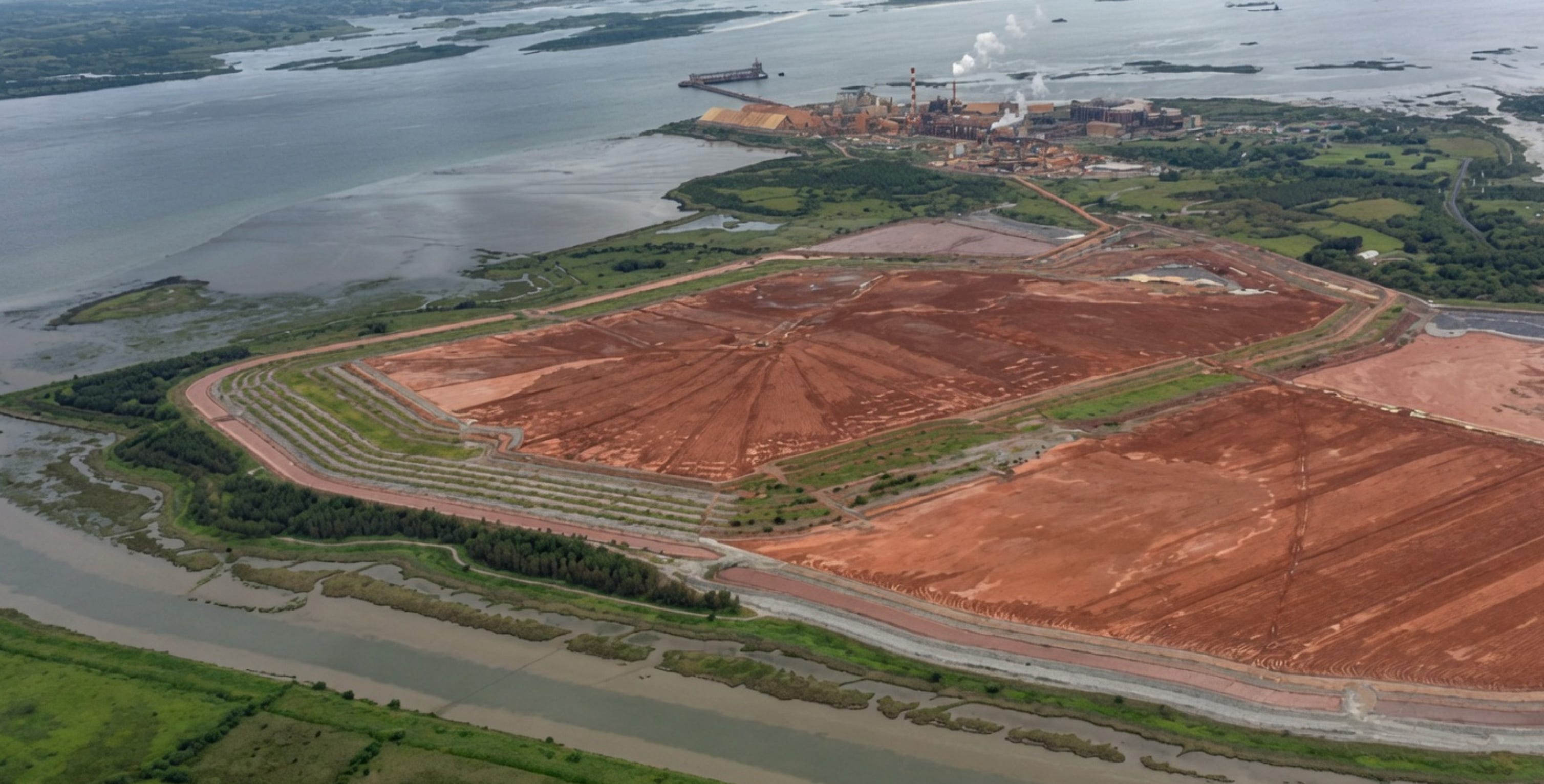
Once manufactured and its excrement deposited, Aughinish alumina is loaded onto ships, which sail up the grey Atlantic, past the watchful ghosts of the British Empire, into the Baltic maw of a nation that is ontologically evil. This is how the world actually works, of course. Not in the clean abstractions of sanctions lists or think-tank white papers, but in these grubby chains of supply: bauxite dug by underpaid hands or slaves, as they used to be called, in the likes of Guinea and Brazil. It is refined in Ireland under EU environmental trade credits and tax arrangements that would make a medieval cardinal blush, shipped to smelters in Siberia or the Urals, extruded into metal, filled with explosives and electronics, and finally hurled, at enormous expense, into the bodies of Ukrainian civilians. Friedrich Engels, in 1845, called this “social murder”; I prefer the term “murder capitalism”. Lots of people die in this logistics chain and similar other murder manufacturing supply chains around Europe. “Murder capitalism” is something that is utterly barbaric and reprehensible, which is allowed to happen so jobs can be saved in somewhere like Limerick. It is always Western countries where the jobs have to be kept at the expense of other people’s lives. People measure how far a society has come in GDP terms or GNP terms. Quite frankly, it should probably be measured by how many jobs your country has saved by letting people in other countries die. The mirror I’m holding up might appear somewhat uncomfortable right now….Some people call it Realpolitik, I suppose.
But think about it. Somewhere in the verdant damp of the Foynes Estuary in County Limerick, under the low grey Irish sky that would remind you of a sullen politician like it’s apologising for something, great war-enabling refineries churn away. How is that neutrality? Frank McCourt said in his Pulitzer Prize-winning Angela’s Ashes, “Limerick gained a reputation for piety, but we knew it was only the rain.” Similar could be said of the Irish Government’s reputation for piety when it comes to talking about Ireland being “strictly neutral”.
Ireland’s so-called “military neutrality” is one of those polite fictions that the Irish state clings to like a drowning man to a life raft made of turf. It’s not neutrality; it’s more like a cosplay, a tricolour-waving ritual that lets the country pretend it’s still the plucky underdog of Europe while quietly feeding a genocidal Russian war machine on the other side of the continent. In the first quarter of 2026, eighty-three per cent of Ireland’s alumina exports went straight to Russia. Not some vague “neutral” transaction, something for the ledgers but the raw materials of missiles and shells, the metallic marrow of a war of aggression. Ukrainian children are being shredded by the consequences of the Irish State, no matter how much we bleat about our neutrality. Alumina out of Ireland, into Russian smelters, out as components for the artillery that’s been grinding down Ukraine and beyond. The government knows. Of course it knows. But knowledge at those latitudes is a flexible thing. It bends around profits the way a medieval scholastic bends Scripture around whatever earthly vice needs theological cover. They’ll condemn the invasion in the Dáil with all the fire of a damp match, then sign off on the next 14 shipments to St Petersburg every month to fuel the Russian war machine, with the quiet satisfaction of men who understand how the world really works. This isn’t neutrality. It’s the oldest story in the book: the small country that sells its soul in instalments, telling itself each time that the price was worth it, that history will forgive the compromise. The compromise here is that on one hand, Ireland has taken in 80,000 Ukrainian refugees, but on the other hand, we’re enabling the tools of Russia’s war machine that cause those people to flee to Ireland.
And yet the outrage is exquisitely selective from some parts. We are to believe that this particular case is a scandal, a moral failure of Dublin and not the E.U. Ireland is not alone. In Switzerland, vast rivers of components, machine tools, dual-use chemicals, and outright weapons-grade materiel are flowing into the conflict daily from that famously neutral country. STMicroelectronics, a company with facilities in France and Italy were found most frequently in Russian weapons. A Dutch company, NXP, has had its components discovered in drones, ballistic and cruise missiles and communications equipment. A German company, Infineon Technologies, a spin-off of Siemens, has components regularly found in Russian weaponry. Rivers of silicon and steel snaking their way eastward. The ingredients of war being imported from every direction are merely the regrettable necessities of geopolitics. The material flows. The missiles fly. Civilians die.
The Aughinish Trap
Irish politicians and the European Commission stand before us with solemn faces, hands clasped piously over their green hearts, and declare with perfect bureaucratic calm: there are, at this time, no sanctions upon Aughinish Alumina. Nothing to see here. Just a little refinery in Limerick, humming away, cheerfully shipping thousands of tonnes of alumina off to St Petersburg, where it will no doubt find its way into the fuselages of missiles and the shells that rain down on Ukrainian cities. When politicians say they have no evidence of Aughinish alumina finding its way into Russian weapons, what do they think they are making with it? Tinfoil hats? Its owner? Oleg Deripaska, Putin’s favourite oligarch, is a man already sanctioned by the EU, the UK, the US, Australia, and Canada. A walking embodiment of Kremlin kleptocracy. But sanctions? For us? Perish the thought. That would be self-defeating, you see. Jobs. Supply chains. The sacred European economy. One mustn’t be hasty. Irish politicians from all political parties have been pouring honey in to journlists ears, whispering - think of the job losses…..
Meanwhile, the same Irish politicans strides forth like a moral colossus, sleeves rolled up, ready to pass the Occupied Territories Bill. This noble piece of legislation will ban Irish trade with goods and services from illegal Israeli settlements. How virtuous! How consistent with international law! How loudly we shall clap ourselves on the back for refusing to sully our hands with the produce of illegal occupation.
But the Occupied Territories Bill will likely cost Ireland far more jobs than stopping Aughinish Alumina from exporting a vital war material component to Russia. 38 U.S. states have anti-boycott legislation, which were introduced to protect Israel. The Taoiseach himself said last week that 250,000 jobs were at stake.
This is the trap, sprung wide open. Find us the Irish politician brave enough, or cynical enough, to stand in our parliment and say, with a straight face: “We must accept job losses to sanction this illegal occupation, because it is righteous and symbolic, but not that occupation. That one pays wages in Limerick, feeds the grid, and keeps the European machine humming. There’s a word for that. The mind boogles at the grandeur of it. Here is Ireland that spent centuries under foreign occupation itself, now lecturing the world on the sanctity of other people’s lands, while quietly ensuring that its own ports and factories keep the war machine of a nuclear aggressor well-oiled and humming. Oleg Deripaska’s alumina flows. The profits accrue. The alumina becomes aluminium becomes drones becomes death.
This is not foreign policy, nor is it statesmanship; it is moral arbitrage. Ireland, land of centuries under occupation, now expertly weighing which occupations deserve the lash. It’s a grotesque little morality play in which Ireland casts itself as the conscience of Europe, while its chimneys in Limerick belch out the raw materials of someone else’s slaughter, and our farmland resembles the killing fields of Ukraine that we help turn blood red. The hypocrisy isn’t hidden; it’s a badge worn proudly, murder capitalism it reads. A mark of a truly industrial nation. But Ireland isn’t to blame here. The market, that great blind idiot god, continues its eternal work of turning dirt into death and death into dividends. Aughinish Alumina is not an outlier; it’s the same system that sells us electric cars while strip-mining Congo for cobalt, that lectures us on net zero while fuelling wars with the refined products of the earth.
Craft, and not sorrow, is seen in a hypocrite's tears.
Ireland - The Cosseted Child of Europe

Ukrainian President Volodymyr Zelensky arrived in Ireland this week for his first official state visit. Extensive security measures were put in place across Dublin and the surrounding areas ahead of the high-profile visit. It has since emerged that four military drones breached a no-fly zone and flew toward Zelensky’s plane shortly before it landed at Dublin Airport on Monday night. They were drones, but not the sort you buzz the neighbour’s cat with. It is being reported that these were serious, military-grade pieces of hardware, and for two unhurried hours, they did lazy, insolent loops in the sky above an Irish naval vessel, their navigation lights brazenly glowing in the dark. It was less an intrusion than a slow, deliberate loitering, a military mechanical staring contest.
Deeply disturbing but so important to read. Just one example of so many similar stories aiding and abetting all the wars. Tragedies all over and no end in sight.
This was poetic