

133 Times the Limit
Arsenic and aluminum in the waters around Aughinish

The water is pure. It tastes of nothing, it’s for the most part bland; it is the colour of nothing, harmless really, but there’s arsenic in the groundwater around Aughnish, which is being reported by Conor Gallagher in the Irish Times to be 133 times the legal limit. Arsenic does not announce itself. It does not stain the glass or leave a metallic aftertaste on the tongue. It is omnipresent but invisible. It simply arrives, dissolves, and remains invisible, waiting. The problem, you see, is not the poison itself but the labour of persuasion of convincing the entire Aughinish community and surrounding areas that the clear, boring, tasteless water they have always drawn from the ground is, in fact, a slow and patient poisonous assassin living inside them. But the farmers around Aughinish know this and have been telling us for almost three decades.
Once arsenic is ingested over and over, the body begins its convulsions. Skin rises in dark, leprous patches; the gut seizes and empties itself in violent spasms; blood appears in the vomit like a private confession. Later come the more ambitious and deleterious failures: the bladder, the lungs, the kidneys, the skin itself turning traitor, blossoming into cancers that feel almost too personal in their thoroughness. These are not subtle afflictions; they are loud, wet, and unmistakable in their suffering. Yet without the correct scientific name attached to them, they remain ordinary misfortunes, the usual degradations of poverty, of bad luck, of living too long in a place that has never loved you. The arsenic does not merely poison; it renders the entire catalogue of human misery indistinguishable from itself. The farmers know this. They have been telling us for almost three decades now, but who is listening?
When Micheál Martin still wore the title of Minister for Health, he met with Pat Geoghegan of the Cappagh Farmers Support Group on three separate occasions between 2001 and 2003. The meetings have the quality of a half-forgotten political ritual: the minister, the farmer activist, the quiet exchange of papers that somehow never quite became a plan of action, but people often forget Michéal Martin is a Bertie Ahern school of politics alumnus, verba non acta was a political adroitness they practised as a matter of faith. Micheál Martin and Fianna Fáil have known about the allegations against Aughinish Alumina for more than a quarter of a century now, long enough for the knowledge itself to have calcified into something like a tradition, a secret everyone pretends is still secret.
Niall Collins, the local Fianna Fáil TD and fatuus, has perfected the art of the dismissive yawn. Challenge him on the health effects of the refinery, or on the quiet shipment of war material towards Russia, and the yawn arrives on cue, a soft, parliamentary exhalation that is meant to signal how very boring the whole subject has become. On the current-affairs circuit, Collins has been a tireless lapa an chait for Aughinish Alumina. He even told RTÉ, with the serene confidence of a man preparing to invade Ukraine, that “there has been no law, regulation, condition of licence or EU sanction that has been broken by the Aughinish plant.” This is untrue. In 2001, the plant released five hundred thousand litres of highly alkaline effluent into the Shannon estuary, an event large enough to register on the scale of an industrial accident, yet somehow too small to register on the scale of political memory. The company only contacted the Environmental Protection Agency fifteen hours after the spill. Describing the substance as “extremely alkaline”, Dr Gerry Byrne, programme manager for the EPA, said in court that it “posed a threat to human health and would have killed all flora and fauna which came into contact with it, as it flowed into the estuary”. How did Collins not know this? How did he fail to research or notice that his own party leader had once been heavily involved in an investigation into the same facility while serving as Minister for Health? Collins will tell you it is all about employment. Jobs for the pollution. Jobs for the Russian war machine. There is a peculiar modern political degradation in Collins's appraisement: the willingness to prostitute a landscape, and the people who still live on it, for the continued favour of a fascist dictatorship and a sanctioned Russian oligarch that is slowly, methodically poisoning the very ground one is elected to represent. It is a new low, or perhaps simply the logical endpoint of Irish politics that has long preferred the abstract glow of “jobs” to the concrete fact of dying animals and sickened bodies. Aughinish Alumni received a conviction for criminal behaviour for the incident. And yet Collins, poor Collins, somehow remained innocent of this fact. How? One imagines the parliamentary assistants, those Nazgul-like interns and half-wit careerists who orbit him like moths around a dying flame, each possessed with a government-issue laptop and the theoretical intellectual capacity to type a few words into the great glass oracle of Google. Surely one of them could have managed to Google “Aughinish Alumnia?”
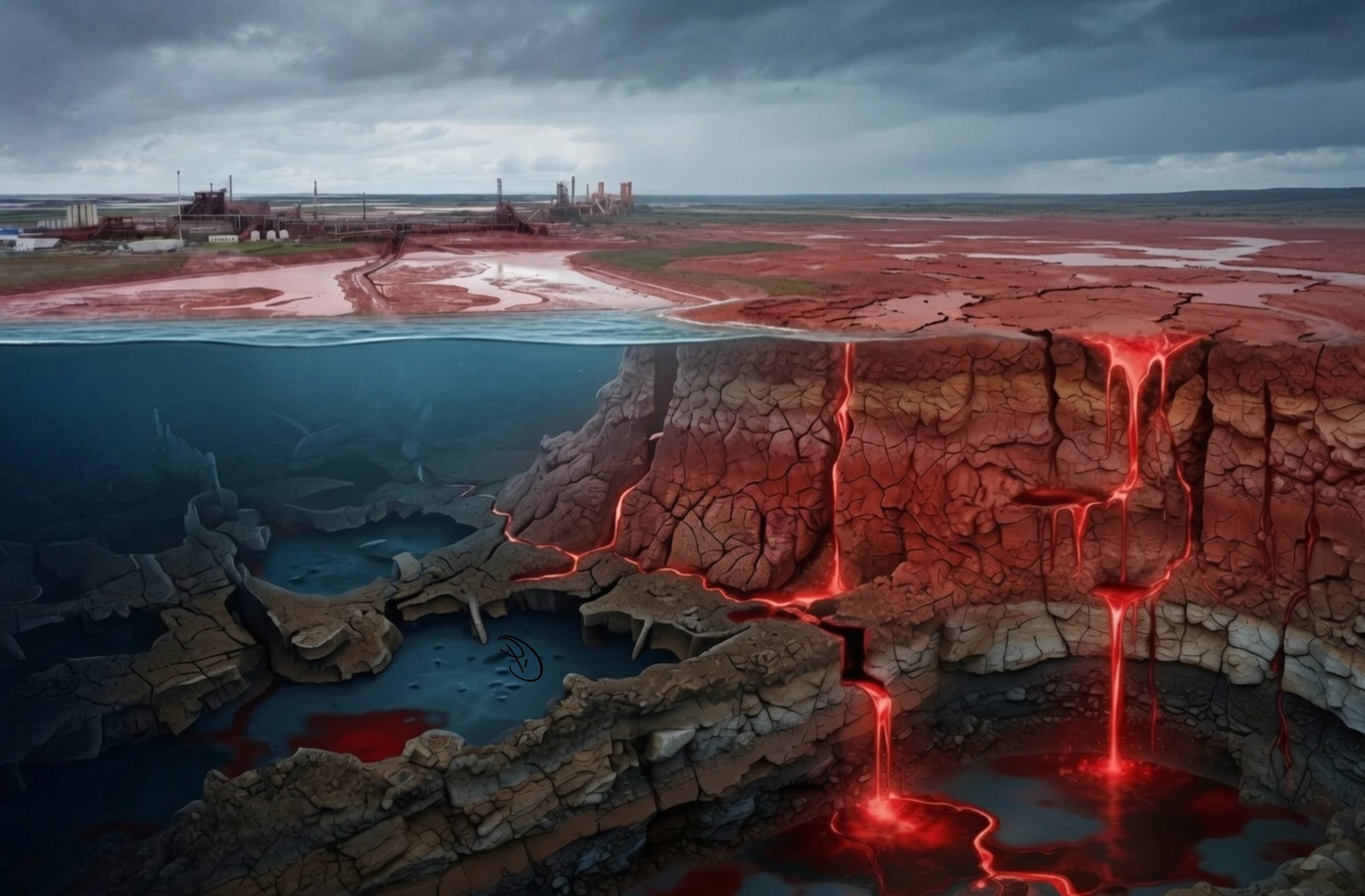
The land itself is also saturated with aluminium toxicity, a quiet, metallic saturation that does not announce itself with drama, but like the arsenic, simply waits. At the start of 2026, one observation well returned aluminium concentrations 4,735 times the threshold for groundwater, precisely double the already grotesque figure recorded at the close of 2025. Acute aluminium poisoning remains uncommon among cattle, sheep, goats, horses and pigs; the real work is slower, a chronic attrition that arrives through contaminated water, acidic soils that liberate the metal more readily, tainted feed or silage. The animals begin to refuse their food, lose weight, grow poorly; dairy herds yield less milk. Aluminium interferes with the absorption of phosphorus, magnesium and calcium, producing secondary deficiencies that mimic grass tetany, muscle tremors, stiffness, and tetanic spasms. Anaemia appears, blood parameters shift, and bones demineralise or deform under prolonged assault. In the worst documented cases, the pathology grows more intimate still: subclinical ketosis, reproductive abnormalities, excessive uterine bleeding at calving, the land’s poison will find its way into the very mechanics of birth and milk and blood. But the farmers around Aughnish have been telling us this has been going on for nearly three decades now.
The arsenic and the aluminium have already done their work. They seep through the soil and the aquifers around Aughinish with the quiet persistence of a civil servant filing forms, turning the water into a metallic slurry and the land into something that no longer quite belongs to the living. The EPA, whose sole metabolic function is the protection of the environment, has elected to do very little. It continues its three-decade predilection of non-action, emitting the soft susurration of institutional indifference while the poison accumulates. In 2001, seventeen human tissue samples from local farmers held the quiet promise of answers, seventeen small, irreplaceable samples of flesh and blood from the area that might have spoken of the poisons circulating in the air, the water and the soil around Aughinish. They were not abstract data points on an EPA spreadsheet; they were pieces of people taken in the official name of public health, and then the samples simply vanished. When the loss came to light, the Agency did not raise the alarm or demand accountability. It merely absorbed the disappearance the way the land around Aughinish has been absorbing poison, treating the absence of those seventeen samples - and of whatever truths they might have carried - as one more inconvenient footnote in the long, accumulating scandal of Aughinish. Seventeen human samples gone missing: the stuff of conspiracy theories, of a Hollywood blockbuster that writes itself, or, at the very least, there should have been an investigation by the state. The State did, in its ponderous way, attempt an investigation. It spent €5.3 million, an almost respectable sum, and then, for reasons that remain opaque even to those paid to understand them, Micheál Martin, our current Taoiseach, shut the whole thing down. A journalist eventually carried the news to the devastated Geoghegan family. At this point, the narrative begins to acquire the unmistakable flavour of a good old-fashioned political conspiracy theory, the kind that writes itself in the margins of official Ireland’s silence.
The next time Niall Collins emerges from whatever combinatorial fog of constituency offices and press briefings to defend the plant, or the next time a journalist is dispatched to extract from the Environmental Protection Agency some explanation of what, precisely, is occurring at Aughinish Alumina, a different question should be asked. Not the usual one about compliance or monitoring or the delicate balance of economic necessity. Ask them, instead, if they would have the Alumina factory in their area, whether they would bathe in it. Whether they would drink it. Whether they would lower their own children into that bauxite-bright water and watch the metallic sheen cling to their skin. Whether they would carve the meat of animals that have fed on the same poisoned ground and set it, still warm, upon their own tables. The answer, of course, will never come. It would appear the governmental machinery of official reassurance is not calibrated for such inquiries when it comes to Aughinish Alumnia. It prefers the abstract, the distant, the carefully non-corporeal. But the question remains, hanging in the air like the residual taste of aluminium on the tongue: would you?
Aughinish means the Island of the Horse, an old name perhaps, gentle and faintly mythic, as if the place had once been the private paddock of some forgotten god who kept his favourite beasts there, grazing on salt grass and supping the soft Atlantic rain. Now the horses are gone, and in their place stands Aughinish Alumina: a vast, humming toxic refinery that sucks bauxite from the other side of the world and sweats it into aluminium, the bright, indifferent war metal of the modern age. The tragedy is almost too Irish to be believed. Niall Collins TD is the Minister of State at the Department of Agriculture, Food and the Marine with responsibility for Forestry, Farm Safety and Horticulture. He’s meant to be the guy in charge of stopping the pollution. The land and the water that once fed the island have been quietly murdered by the same process that was meant to enrich it. Toxic air drifts across the fields like a curse no one remembers speaking; the rivers and the groundwater carry a slow, chemical death that does not announce itself with colour or smell. Farm animals collapse in the pastures, their bodies failing in ways that look like ordinary misfortune until you count how many of them are dying. And the people who still live in the shadow of the chimneys discover, one illness at a time, that their own flesh has become continuous with the poisoned earth. The Island of the Horse has become something else entirely: a place where the only remaining animals are the ones that have not yet finished dying. The Island of the Horse keeps its old name, but the horses are gone, and the only thing still being ridden is the land itself.