

Shots Fired Again
Nothing ever changes.

It keeps happening. Not often enough to be normal, not rarely enough to be surprising. But there is something almost ritualistic now about the American presidency and gunfire: the crack of a rifle as punctuation, the sudden rearrangement of bodies into panic and choreography.
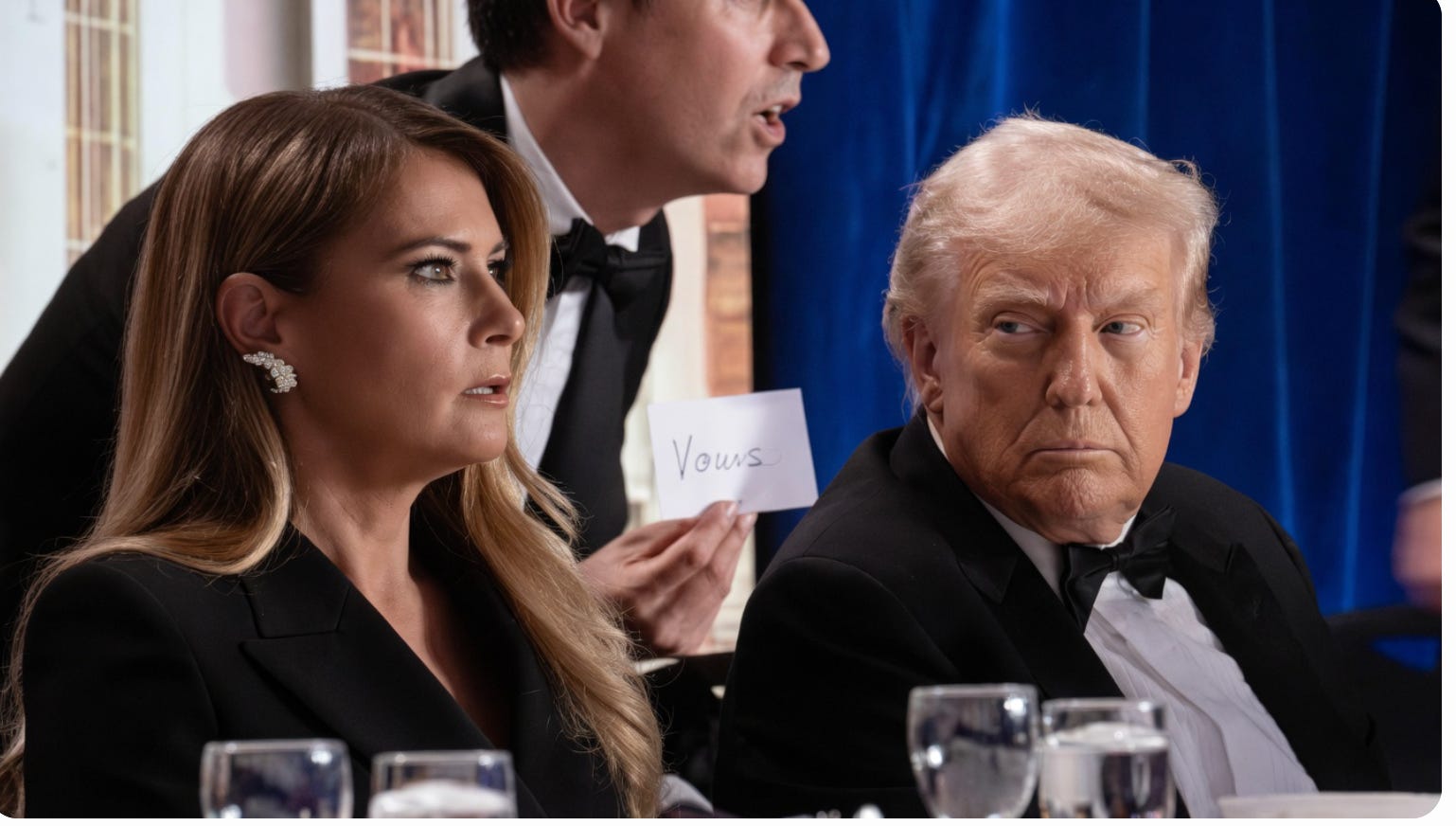
On Saturday night, beneath the anxious glitter of the White House Correspondents’ Dinner, those marble halls thick with the brittle laughter of journalists who secretly despise their own sycophancy, Donald Trump was once again bundled offstage like a valuable prop in a play that refuses to end. Shots rang out, that distinct American timbre: equal parts frontier myth, constitutional onanism, and the low, idiot hum of a nation marinated in lead. Secret Service agents moved with the grim choreography of men who have rehearsed this dance too many times, bodies folding into practised geometry. Attendees, whose entire careers are spent narrating power from a safe remove, found themselves performing the oldest and most honest ritual available: crawling under tables, hearts hammering, suddenly mortal again. Trump, Melania, and Vance were extracted like sacred relics from a museum already on fire.
It is no longer an aberration. It is a pattern, or perhaps a genre.
America is a country that loves its presidents the way a moth loves a candle flame: with a fatal, fluttering stupidity. The office is draped in pomp and solemnity, but the real tradition, the genuine, unbroken thread of American political life, is the sound of a gun going off somewhere aimed at a president. Somebody, eventually, is always going to try to kill the president. It’s about the most American thing you can do, right up there with baseball or American Football. This is the genuine, unbroken thread of American political life. Not the Constitution, not the endless squabble over rights and liberties, but the quiet, patient expectation that somebody, eventually, is going to try to kill the president. It is practically a civic sacrament. The moth doesn’t hate the flame. It is simply compelled, wired by some idiot evolutionary logic to seek the brightest, hottest thing in the room and immolate itself against it. So too with the republic. The U.S.A. crowns its leaders in the language of destiny and then, with a kind of tender inevitability, begins loading the magazines. The gun is not an aberration. It is a love letter.
Lincoln, Garfield, McKinley, Kennedy: four dead presidents, each one a small catastrophe in a different costume. Then the near-misses, the grazes, the failed attempts, the lunatics with grievances and pistols and some private theology of history. Teddy Roosevelt speaking with a bullet in his chest. FDR almost died before he even got the job. Truman woke up to gunfire outside Blair House and was, by all accounts, mostly irritated. Ford survived two women trying to murder him, and looked like he had developed an existential allergy to the office. Reagan was hit because a man wanted to impress an actress.
America does not merely have political violence. It has a political relationship to violence so intimate it can barely be distinguished from patriotism. The republic looks at itself and thinks that it ought to be stable, solemn, and permanent, and then immediately remembers it was built by men with guns and never really stopped being that. The president stands at the centre of the performance, smiling under the lights, while somewhere in the wings, history loads another round. The bullet misses most of the time. That is the most comforting thing that can be said about it. But “most of the time” is doing a lot of heavy lifting there.
In July 2024, in Butler, Pennsylvania, Trump stood before a rally crowd when a shooter, elevated both physically and symbolically above the scene, opened fire. A man in the audience died. Others were wounded. Trump himself was grazed, a thin, almost theatrical wound to the ear, the perfect crimson rivulet down the cheek, in a way that cameras could understand. It set the political strategists grinning like wolves in the dark of our war-rooms, lips peeled back over teeth that had already tasted blood, because we knew, oh, we too knew well, what it means when a presidential candidate survives an assassination attempt. Trump raised a fist, shouted “Fight!”, and was carried away, already transformed into an icon, a living relic of American violence sanctified by proximity to death. Kamala didn’t stand a chance.
Two months later, in Florida, the threat was quieter but no less operatic. A rifle emerged from the foliage at his golf club, an AK-style weapon, fitted with a scope, accompanied by the strange accessories of modern violence: backpacks, a GoPro, the full pathetic regalia of the modern lone wolf, turning regicide into content. Trump was untouched. The man responsible would later be sentenced to life, his motivations dissolving into the usual slurry of grievance and delusion.
Then, in the wet grey throat of February 2026, another supplicant came crawling toward the perimeter of Mar-a-Lago, a young man clutching a shotgun in one hand and a petrol canister in the other, piecing together his private apocalypse from the cheapest available materials. The Secret Service cut him down before the story could even swallow him whole. A brief, perfunctory violence. No spectacle. No cameras drinking deep. Just the wet pop of duty, his martyrdom stillborn. Trump was not even there.
And now this: another ballroom, another scattering of bodies, another reminder that proximity to power in America is always also proximity to violence. The same hotel where Ronald Reagan was shot in 1981, history repeating itself, not as farce exactly, but as something flatter, more procedural. Less shock, more expectation. Every aftermath begins as an outrage and ends as a familiar American genre: the security failure, the public panic, the rehearsed debate about motive, the solemn promises that this time things will be different. But the country never quite breaks the pattern because the pattern is baked into the spectacle. The presidency is an instrument for concentrating attention, and concentrated attention in America eventually attracts a gun. The office is not just powerful. It is visible, symbolic, and endlessly narrativised, all the things that make a person venerable to the national imagination and vulnerable to its ugliest impulses.
The strange thing is not that these events keep happening. It is how quickly they are absorbed. Each incident arrives with the weight of rupture and leaves as just another data point, another entry in the expanding archive of nearly catastrophic events. The presidency continues, the dinners resume, the headlines rearrange themselves. That is the part Americans prefer not to dwell on. They like the monuments, the biographies, the posthumous nobility. They like to imagine violence as an interruption to the system rather than one of its recurring outputs. But the republic has always lived with the possibility that someone, somewhere, will decide the ultimate end to a political argument is to pull the trigger. That is not a glitch in the design of the Republic. It is one of the design’s oldest features.
Gunfire, applause, evacuation. The rhythm holds.
Listen to the podcast below.

Actually this is good practice about being a target. Heaven knows all the children in our school
system fear this every day: having to duck under tables or scramble to a closet to avoid those with guns. But the gun lobby has huge coffers.
As an American it is affirming to read such an accurate analysis from across the pond.